I love how you can breathe in botanical names as if it's a shopping list.
~Katherine Jones
Well, the weather here has been atrocious…relatively speaking. Our normal winter of mild temps has turned arctic-esque again and we are just waiting for the rain to return tomorrow and melt all this snow and ice away. Normally we get a week or so in February of dry, sunny days and balmy temps, luring every gardener out to prune roses and do some general cleanup. I postponed my rose pruning because I knew this freeze was coming. On a happier note, another much anticipated warming activity in February is the annual Northwest Flower and Garden Show in Seattle. Acres (at least it seems like) of gardens, plants, vendors booths, seminars and wonderful people (gardeners are really nice) all milling around, dreaming big dreams and soaking up a bit of paradise.
There were 24 display gardens to spur-on the imagination this year. They are really big and each is planned according to the show theme of the year. The 2011 theme is “Once Upon A Time: Spectacular Gardens with Stories to Tell”. Frankly half the time I don’t get the theme out of the design I see, but I don’t really care. It’s about the inspiration for me and what ideas I can take from the show to my own garden. The first garden I saw ended up being my favorite. Lots of nooks and crannies with well made classy sheds using recycled parts and old wood windows. That’s my kind of construction. When I rounded the corner and saw the name of the nursery that designed and implemented it…well I wasn’t surprised. It was Christianson’s Nursery ...my all time favorite! Their nursery is just like this. Well done. If you can, you must visit.
By the time it was to leave I hadn’t seen the whole show. I don’t know if it’s possible in one day and this time I got held up at Andy’s Orchids booth. There are always several orchid vendors there but Andy’s has orchids for the true orchid geek. Not all in showy, tempting bloom of run of the mill varieties that can be had from your local grocery store (which are lovely and I have several) at half the price they wanted at the show. No, Andy’s had a huge selection of more rare and unusual species, not all in flower but he was quick to pull up a photo of the flower for you to see on his laptop. And he was happy to just talk orchids. No hard sell, no quick-sell-and-on-to-the-next-customer. Just sharing his knowledge and he really wanted to make sure you chose the orchid best suited to your situation and experience. A really neat guy. If you are into orchids and are going to a regional flower show, maybe he’ll be there. He’s worth searching out. If you are lucky enough to be near Encinitas, CA you could visit him. Oh and yes, I bought an orchid, dendrobium pugioniforme. Now I have nine of differing species. Darn things are just so addicting! I don’t even get them to bloom again every year but I live in high hopes…either that or delusion, but I’m learning. A few weeks ago I found the best online forum which is a huge and very helpful resource. That and a few library books and I’m confident I’ll get more blooms this year.
Back at the show, most of the display gardens had water features too. This ball with water enveloping it from an outlet at the top was my fav. The water fell so softly there was no sound and barely a ripple on the water’s surface. It was simply beautiful. And the flat, open patio for seating…ahhh, so serene. Yeah I could live there.
I love this quirky idea for a garden shed. I snapped a picture of it to keep in my photo file of future garden ideas. I have lots of old windows and even an old pair of small French doors, all just waiting for a design and space to make a fun garden building or greenhouse. I keep taking pictures and designing it in my head. Hopefully someday it’ll take shape. Someday.
As a matter of fact most of the pictures I take at the show go into a file for future garden ideas. This is a cool idea from the Creative Gardener to use old floor grates as ‘stepping stones’…which from our old house I have a few stowed in the attic.
I’m always sad when this show is over. Not your run-of-the-mill home and garden show, it’s special. We are really fortunate to have it here in our midst. I look forward to it every year, and always come away with something new for the garden. This year I bought some Allium bulbs (Allium sphaerocephalon) which promise a two-tone oblong spring flower of green and purple. How cool is that?? They are already sprouting in the bag so as soon as the ground thaws I’ll plant them. Can’t wait to see the bloom!
As I often do, I listed websites and extolled the virtues of a few businesses here today. I do so because I love passing on great information…nothing here is a paid endorsement.
In Bloom In My Garden Today: Cyclamen coum, crocus, primrose (double English), Heleborus, Bellis perennis (English Daisy), violet primrose, Sarcococca, Galanthus elwesii (snowdrops)
Author’s photos
Monday, February 28, 2011
Tuesday, February 8, 2011
Water In The Garden
Meanwhile, let us have a sip of tea. The afternoon glow is brightening the bamboos, the fountains are bubbling with delight, the soughing of the pines is heard in our kettle. Let us dream of evanescence, and linger in the beautiful foolishness of things.
~Okakura Kakuzo The Book of Tea
Ahhh, the fountains are bubbling with delight. Can’t you just hear them? I love the above quote, it paints such a tranquil scene. Being near a fountain is so restful to me, it promotes a peaceful calm.
Water has long been linked to easing the troubled spirit and can be enjoyed by all. The hearing impaired can gain from the visual relaxation cascading water brings and the sight impaired can hear the tranquil splashing. There is a tactile pleasure too…one young visitor to my garden had so much fun returning again and again to my tall pot fountain pictured here, plunging her hands and arms into the cool water several times on a warm day.
Your visiting wildlife will thank you for it too. I’ve often seen birds visit my ground level bubbler (below) for a drink or cleansing splash and squirrels often drink from it.
I have created two fountains for my garden. They were not expensive to make, nor do they take up a lot of room. The above tall pot style could even be used on a balcony. I have it situated under my study window. When the window is open for a summer’s breeze I can enjoy the water’s sounds while inside the house too.
Adding a water feature to your life is really as easy as 1,2,3…4.
1. leak proof container
2. pump
3. spout
4. electricity nearby
To make a fountain you need to decide if you want it above ground or below. Above ground fountains need more refilling to offset evaporation however, the top pictured fountain is easiest to create, although the more costly of the two. For a pot style fountain like mine you’ll need
• a tall pot
• a submersible electric pump (from a hardware/garden center or nursery)
• something the water can spill out of, a spout of your choosing. There are many spout styles at nurseries and garden centers. Some are metal, plastic or bamboo. I made the copper one pictured above from ½ inch copper tubing, some copper wire and soldering experience gained from many stained glass projects.
Some pots are already painted inside with waterproofing. Some have drainage holes and some do not. If you use an ordinary garden pot like I did, you’ll want to waterproof the interior and plug the drainage hole. In my glazed, terracotta pot I used an exterior, enamel, black, oil base, type of paint to coat the inside walls and bottom. A black pot interior is best for hiding the pump and its cord, which are also black. I also coated it with a liquefied silicone goo which peeled within the first year. I don’t think it is needed, I think the paint is enough. To plug the drainage hole, use silicone. It comes in a tube like glue. Fill the hole, being sure to seal all the sides and edges. When the silicone and paint are dry you are ready to fill it with water and put in your pump.
The pump for this size fountain should not be expensive. My pumps cost around US$20-30. For this size fountain you need only pump the water upward 4 feet (1.21m) or so, depending on how tall your pot is. You’re not making a geyser, unless you choose a pot 4 ft tall or more. My pot is about 19 inches (48cm) tall. A four foot rise of water may sound like too much but realize the pump only gets it up to that height and no more. At the 4 foot mark it’s only a dribble but it’s enough to get it to your spout. The distance to the top of my spout from the pump is 15 inches (38 cm). I get about an inch more of height before it cascades and softly splashes into the water below. If you want shooting water you’ll need a higher rise, but be aware, vigorously splashing water may not all land back into your pot, and could empty your water volume faster. Read the package label, it should indicate how high a rise each pump will create. My pump with a 4 foot rise is 120Volts, 9 Watts. These pumps also have a flow control adjustment dial, so you do have some ability to tweak the flow. I keep mine fully open. Attach the pump to your spout of choice, add water, plug it in and voila! You have a relaxing fountain.
Here is a close up showing the pump. It just hangs as is connected to the spout, and the cord comes up and over the back of the pot. Yes the cord shows, but being black is not glaring. My copper spout didn’t ‘hold’ the pump. It just fell out so I purchased some vinyl tubing which fits into the copper and is just right to hold the outlet of the pump. A minor complication that I can elaborate on in comments if you are interested in making your own spout. To comment just click on the word ‘comment’ at the bottom of the post.
My other fountain pictured is a below-ground style. All you really see is water bubbling up from the flat stones (which I found while digging in the garden). For it you need a few more items.
• a dark grey or black plastic bin that will hold two or three gallons of water
• hardware cloth, cut and shaped into a ‘lid’ to fit over the bin, with a hole cut in the center for the pump riser
• black or grey nylon window screen material to lay over the hardware cloth, with hole for riser
• a submersible pump with its own plastic riser (most come with risers)
• and rocks to cover the whole thing
This fountain is covered with rocks mostly hiding what’s below. If you use flat rocks like I did, be sure to angle them inward so any splash flows back into the reservoir. The hardware cloth is sturdy enough to hold the rocks that cover it. I spray painted the hardware cloth black because the silver glints in the sunlight where it peeks through the rock layer. The window screen material over the top keeps out smaller debris which keeps the water and pump cleaner for longer periods of time.
• Dig your hole to fit the bin so the rim is just slightly above the dirt level. Too low and dirt will get in.
I have the same size pump for both fountains but since the water doesn’t need to rise as far for this one it has a stronger bubbling flow before it falls back down onto itself. At first I used a blue bin, thinking it wouldn’t show as I’d be covering it with rocks. It did. Keep everything you use black or dark grey and it won’t show. Even the window screen material in the picture could be darker.
Think about maintenance cleaning while you are designing it. You’ll need to drain it and/or get at the pump 2 or more times per year, depending on how much debris gets into it. If you make it too complicated to disassemble you won’t clean it often enough to keep the pump functioning. Goo in the water collects in the pump, which can clog and burn out a pump in no time and you’ll be spending more $ on pumps than is necessary.
Electricity is a problem you say? Nothing a heavy duty outdoor extension cord and a shovel won’t fix. Neither of my fountains are inches away from an electrical outlet. One is about 6 feet away and the other 10 feet away from the exterior outlet. I connected them by burying heavy duty extension cords in the garden and/or lawn several inches deep into the soil. Always be mindful of where they are as you dig and weed in the garden. Several inches should be deep enough in a lawn to not be touched by a lawn mower but if you have a lawn service contracted to maintain your grass be aware a gas powered edger blade could reach the cord. Be cautious where you bury your cords and how deeply.
I connected both to automatic timers so they don’t run 24/7. I want to save electricity and being in an urban setting, I don’t want to disturb my neighbors when they are trying to sleep on a warm summer night with open windows. There are exterior timers that have covers to protect the mechanism from the weather.
Lastly if you get freezing temps in winter you do need to drain the fountains and put them away. I drain the pot and put the pump and spout in the garage. For the below ground one I leave it all intact but unplug it and cover it so it won’t freeze. Our mild Pacific Northwest winters are not usually harsh, so that’s all I need to do. Naturally if you get hard winter weather you’ll need to dissemble it more.
So there it is, only 4 easy steps to install a water feature in your garden today…ok, you need water too…so that’d be 5.
In Bloom In My Garden Today: Heleborus, Bellis perennis (English Daisy), violet primrose, Sarcococca, Galanthus elwesii (snowdrops)
Author’s photos
~Okakura Kakuzo The Book of Tea
Ahhh, the fountains are bubbling with delight. Can’t you just hear them? I love the above quote, it paints such a tranquil scene. Being near a fountain is so restful to me, it promotes a peaceful calm.
Water has long been linked to easing the troubled spirit and can be enjoyed by all. The hearing impaired can gain from the visual relaxation cascading water brings and the sight impaired can hear the tranquil splashing. There is a tactile pleasure too…one young visitor to my garden had so much fun returning again and again to my tall pot fountain pictured here, plunging her hands and arms into the cool water several times on a warm day.
Your visiting wildlife will thank you for it too. I’ve often seen birds visit my ground level bubbler (below) for a drink or cleansing splash and squirrels often drink from it.
I have created two fountains for my garden. They were not expensive to make, nor do they take up a lot of room. The above tall pot style could even be used on a balcony. I have it situated under my study window. When the window is open for a summer’s breeze I can enjoy the water’s sounds while inside the house too.
Adding a water feature to your life is really as easy as 1,2,3…4.
1. leak proof container
2. pump
3. spout
4. electricity nearby
To make a fountain you need to decide if you want it above ground or below. Above ground fountains need more refilling to offset evaporation however, the top pictured fountain is easiest to create, although the more costly of the two. For a pot style fountain like mine you’ll need
• a tall pot
• a submersible electric pump (from a hardware/garden center or nursery)
• something the water can spill out of, a spout of your choosing. There are many spout styles at nurseries and garden centers. Some are metal, plastic or bamboo. I made the copper one pictured above from ½ inch copper tubing, some copper wire and soldering experience gained from many stained glass projects.
Some pots are already painted inside with waterproofing. Some have drainage holes and some do not. If you use an ordinary garden pot like I did, you’ll want to waterproof the interior and plug the drainage hole. In my glazed, terracotta pot I used an exterior, enamel, black, oil base, type of paint to coat the inside walls and bottom. A black pot interior is best for hiding the pump and its cord, which are also black. I also coated it with a liquefied silicone goo which peeled within the first year. I don’t think it is needed, I think the paint is enough. To plug the drainage hole, use silicone. It comes in a tube like glue. Fill the hole, being sure to seal all the sides and edges. When the silicone and paint are dry you are ready to fill it with water and put in your pump.
The pump for this size fountain should not be expensive. My pumps cost around US$20-30. For this size fountain you need only pump the water upward 4 feet (1.21m) or so, depending on how tall your pot is. You’re not making a geyser, unless you choose a pot 4 ft tall or more. My pot is about 19 inches (48cm) tall. A four foot rise of water may sound like too much but realize the pump only gets it up to that height and no more. At the 4 foot mark it’s only a dribble but it’s enough to get it to your spout. The distance to the top of my spout from the pump is 15 inches (38 cm). I get about an inch more of height before it cascades and softly splashes into the water below. If you want shooting water you’ll need a higher rise, but be aware, vigorously splashing water may not all land back into your pot, and could empty your water volume faster. Read the package label, it should indicate how high a rise each pump will create. My pump with a 4 foot rise is 120Volts, 9 Watts. These pumps also have a flow control adjustment dial, so you do have some ability to tweak the flow. I keep mine fully open. Attach the pump to your spout of choice, add water, plug it in and voila! You have a relaxing fountain.
My other fountain pictured is a below-ground style. All you really see is water bubbling up from the flat stones (which I found while digging in the garden). For it you need a few more items.
• a dark grey or black plastic bin that will hold two or three gallons of water
• hardware cloth, cut and shaped into a ‘lid’ to fit over the bin, with a hole cut in the center for the pump riser
• black or grey nylon window screen material to lay over the hardware cloth, with hole for riser
• a submersible pump with its own plastic riser (most come with risers)
• and rocks to cover the whole thing
This fountain is covered with rocks mostly hiding what’s below. If you use flat rocks like I did, be sure to angle them inward so any splash flows back into the reservoir. The hardware cloth is sturdy enough to hold the rocks that cover it. I spray painted the hardware cloth black because the silver glints in the sunlight where it peeks through the rock layer. The window screen material over the top keeps out smaller debris which keeps the water and pump cleaner for longer periods of time.
• Put in your pump with riser centered, and electrical cord coming up and out.
• Using tin snips cut your hardware cloth and shape it into a lid that won’t shift around. Cut a hole in the center so the plastic riser (included with your pump) can fit through. Put the lid on the bin and pull the riser up a few inches higher than the top of the lid.
• Cut window screening material to fit with a central hole for the riser also. It can just loosely lie over the top of the lid.
• Bury the cord. Fill it with water.
• Plug it in. Make sure you like how it looks and is not splashing too much. If it is adjust the flow control on the pump or just lower the riser. It’s easier to tweak it before you cover it with rocks. When you love it…
• Now cover the whole thing with rocks. Initially I used the smaller round stones seen in the picture below. Looked great but to dismantle and clean it was a pain so I now use larger, flat, shale like pieces with a few of the smaller round stones to cover any gaps. Much less work to dismantle.
Think about maintenance cleaning while you are designing it. You’ll need to drain it and/or get at the pump 2 or more times per year, depending on how much debris gets into it. If you make it too complicated to disassemble you won’t clean it often enough to keep the pump functioning. Goo in the water collects in the pump, which can clog and burn out a pump in no time and you’ll be spending more $ on pumps than is necessary.
Electricity is a problem you say? Nothing a heavy duty outdoor extension cord and a shovel won’t fix. Neither of my fountains are inches away from an electrical outlet. One is about 6 feet away and the other 10 feet away from the exterior outlet. I connected them by burying heavy duty extension cords in the garden and/or lawn several inches deep into the soil. Always be mindful of where they are as you dig and weed in the garden. Several inches should be deep enough in a lawn to not be touched by a lawn mower but if you have a lawn service contracted to maintain your grass be aware a gas powered edger blade could reach the cord. Be cautious where you bury your cords and how deeply.
I connected both to automatic timers so they don’t run 24/7. I want to save electricity and being in an urban setting, I don’t want to disturb my neighbors when they are trying to sleep on a warm summer night with open windows. There are exterior timers that have covers to protect the mechanism from the weather.
Lastly if you get freezing temps in winter you do need to drain the fountains and put them away. I drain the pot and put the pump and spout in the garage. For the below ground one I leave it all intact but unplug it and cover it so it won’t freeze. Our mild Pacific Northwest winters are not usually harsh, so that’s all I need to do. Naturally if you get hard winter weather you’ll need to dissemble it more.
So there it is, only 4 easy steps to install a water feature in your garden today…ok, you need water too…so that’d be 5.
In Bloom In My Garden Today: Heleborus, Bellis perennis (English Daisy), violet primrose, Sarcococca, Galanthus elwesii (snowdrops)
Author’s photos
Tuesday, February 1, 2011
Apairy Update
“We are getting near,” said Gandalf. “We are on the edge of his bee-pastures.”
~J.R.R. Tolkien, The HobbitWoohoo, the bees are doing well! Finally we’ve had some warm enough weather temps for them to get out on a cleansing flight and for us anxious beekeepers to take a quick peak just in the top to see if they are needing to be fed or even indeed still alive. The Italian bees that I have need it to be about 50F (10C) for all this to happen. My bees often fly on a sunny day at about 45-47F degrees but at 50F degrees they’ll fly and I’ll be able to lift the lid for a quick check without risking a potential death chill to the cluster. I wouldn’t dare remove frames and really dig around in there just now but a quick peek is ok. My dad’s Carnolian bees will fly at cooler temps by a few degrees so are able to get out a little more often during our cool winters. When the time comes to re-queen I may go for a Carnolian next time, but my Italians have been quite hardy. I haven’t lost a hive yet, while many around us have.
When it’s too cold for them to fly and take a peek inside, you never know if they are still alive. I do have a removable bottom board tray under my screened bottom board which collects debris so I can often see ‘activity’ based on what I see in the tray. I was a little concerned a few weeks ago. In winters past I’ve been able to hear the bees within the hive by the age old method of eavesdropping with a ‘drinking glass to the wall’. I hold a glass up to the side of the hive they normally winter-over on (always the sunny south side for mine) moving it around till I can hear a buzz now and then, so I know they are ok. I’ve been trying this several times this winter with no audible success. I even bought an inexpensive stethoscope hoping for an easier method but I just can’t hear a darn thing out of it…not even my own heartbeat! Bah! Since I was pretty sure I’m alive, I checked with my friendly neighborhood nurse and yep, the thing works so I guess I’m just not stethoscope friendly. Dang!!! Am I hard-of-hearing already? I was hoping to not have to get down on my creaky knees with the glass anymore. Well I couldn’t hear them with the glass either this winter so maybe the stethoscope idea isn’t a total loss…yet. Maybe it’s just where they are located. The bottom tray debris collection gives me a great idea of where to start listening.
So, all that to say I was not sure they were still alive. We’ve had a few frigid bouts with air temps and snow, more than normal, but today I’m so happy to report they are alive and well. They are flying and spiraling up, up and away and I think I saw one come back with a little pollen. Here the heaths are blooming, a very important bee plant in cold regions as many are usually in bloom for those first, important winter cleansing flights. I’m putting in a new garden in the parking strip in front of the house and I do believe I’ll be adding a few Erica carnea, the lower growing, ground covering heath. If you want a taller mound of heath consider the Erica darleyensis varieties. Both are most frequently seen in nurseries and either will make your gardens more bee friendly.
The next 2 months are tricky times for bees in my part of the world. Going into winter, this was a strong hive, meaning lots of bees. The queen should have begun to lay eggs by now and their numbers can grow quickly. They’ll go through their food sources faster so I need to keep an eye on if/when they need supplemental food. Plus, there’s a chance our coldest temps are still coming. Hang on little bees, hang on! We can see the light at the end of winter’s tunnel!
All in all it’s a good day and a good report from the apairy.
In Bloom In My Garden Today: Heleborus, Bellis perennis (English Daisy), violet primrose, Sarcococca, Galanthus elwesii (snowdrops),
Authors photo
Wednesday, January 26, 2011
Field Trip: W.W. Seymour Conservatory
To see a World in a Grain of Sand
And a Heaven in a Wild Flower,
Hold Infinity in the palm of your hand
And Eternity in an hour.
~William Blake (Fragment from "Auguries of Innocence")
Nestled in the north end of the city of Tacoma, Washington USA is the W.W. Seymour Botanical Conservatory.
The community is fortunate beyond measure to have such a treasure in its midst. Listed in the city, state and National Historic Registers, the conservatory was built in 1907 and is one of only 3 on the US West Coast, the others being in Seattle and San Francisco.
On any given day, no matter what the weather outside you can walk into this tropical paradise, bask in its warmth and breathe in the beauty. It is kept at a balmy warm temperature and moderate humidity that makes all the plants thrive. The soft background music slows you down so it is easy to spend an hour taking in all the floral displays, which are changed with the seasons or to reflect holiday cheer. With the first step through the door, life’s stress seems to drop off your shoulders. You are transported to an Eden on this earth.
It is home to dozens of orchids…some rare and some fragrant. You’ll find varieties of palm trees, bird of paradise, papyrus, a lemon tree with huge fruits, a koi pond, flowering treasures from around the world, a gift shop and more.
Do you love orchids?…they have more than 200.
Do you love tropicals?…they have more than 250 plant species.
Do you love live music?…you can hear it there the 2nd Sunday of each month.
Do you love statuary?…they have several that reflect ancient African, Maori and Aztec cultures.
Even if you don’t love to garden but need a little (or a lot) of R&R from time to time, conservatories like this deliver! Wow do they deliver!
Do you have a conservatory nearby in your community? Do tell, I may want to come visit some day.
In Bloom In My Garden Today: English Daisy, Sarcococca, violet primrose
Photos courtesy of Pat Chissus
Tuesday, January 18, 2011
Soldier On
"I have seen women looking at jewelry ads with a misty eye and one hand resting on the heart, and I only know what they're feeling because that's how I read the seed catalogs in January."
~Barbara Kingsolver, Animal, Vegetable, Miracle 2007
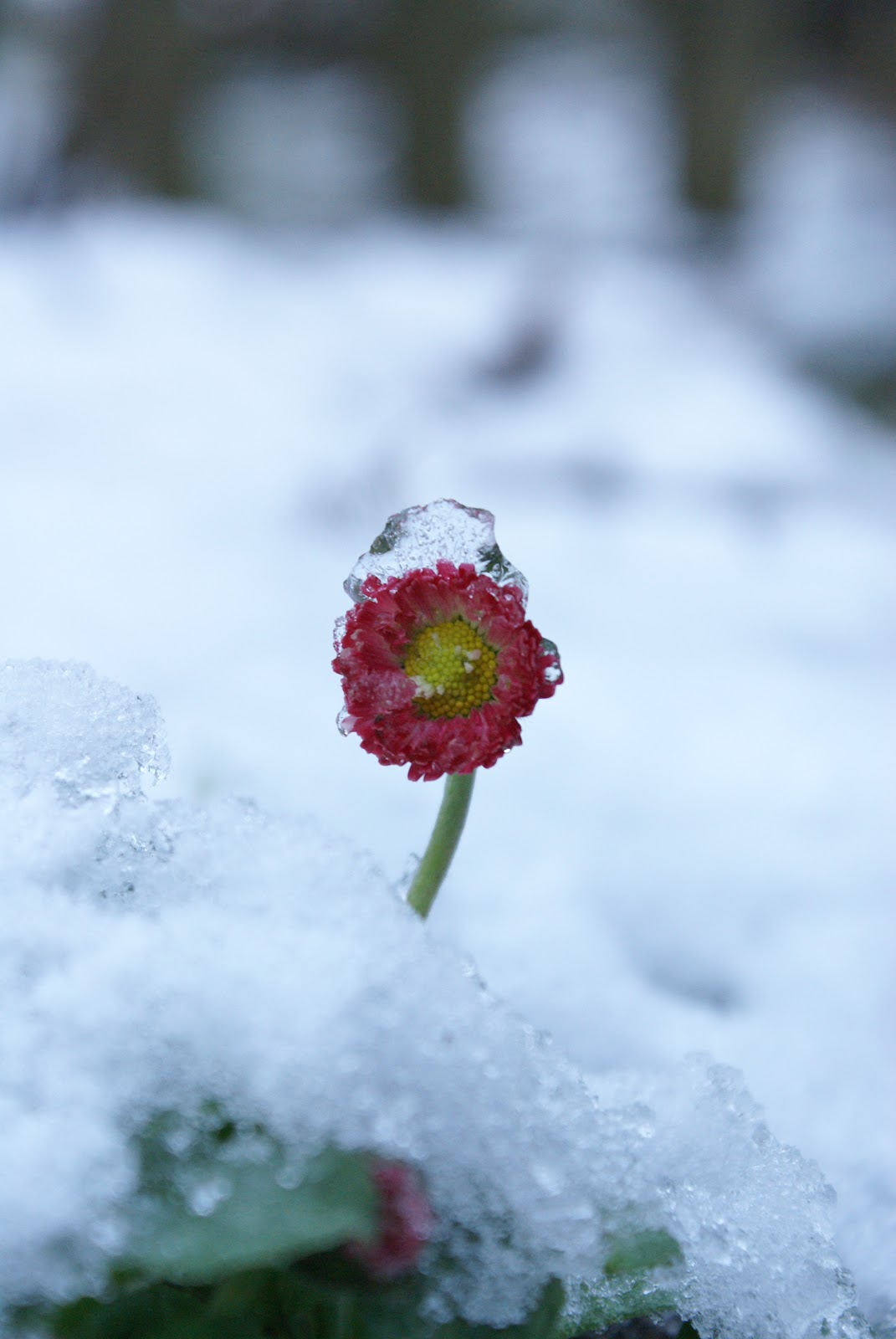
Well my friends I really must apologize to you. In the previous post about the snow that fell last week, I ended it with my usual listing of what’s blooming. I stated ‘no blooms’, but I obviously missed this little one. Check it out…such a trooper!
Have you ever been to Victoria B.C., to their parliament buildings? The expansive lawns are covered with these guys. So charming. Two springs ago, I ordered a packet of seed from Nichols Garden Nursery. I sprinkled some of the seed on my mossy path that leads to my compost bin. I just love diminutive plants amongst the pathway, so long as they don’t trip you and they can handle the occasional foot trod. The seed came up so prolifically I had to thin them out. What fun it is to see their cheerful faces. They bloom nearly non stop, even though the catalog says they are spring blooming. Here it is January and several of them are trying to bloom. Not a huge showing but a few flowers none the less, so on my list they go.
I’ll definitely be sowing some of these treasures in my lawn soon!
In Bloom In My Garden Today: bellis perennis, sarcococcoa, viola
Author’s photo
~Barbara Kingsolver, Animal, Vegetable, Miracle 2007
Well my friends I really must apologize to you. In the previous post about the snow that fell last week, I ended it with my usual listing of what’s blooming. I stated ‘no blooms’, but I obviously missed this little one. Check it out…such a trooper!
This is English Daisy (Bellis perennis), native to Europe and the Mediterranean region. This particular one is a horticultural variety I believe. The original species are single flowers, mostly white with a bit of pinkish tinge. It is a meadow plant that needs good soil, moisture, light shade in hot areas and full sun in cooler areas. It is super easy to sow from seed.
Have you ever been to Victoria B.C., to their parliament buildings? The expansive lawns are covered with these guys. So charming. Two springs ago, I ordered a packet of seed from Nichols Garden Nursery. I sprinkled some of the seed on my mossy path that leads to my compost bin. I just love diminutive plants amongst the pathway, so long as they don’t trip you and they can handle the occasional foot trod. The seed came up so prolifically I had to thin them out. What fun it is to see their cheerful faces. They bloom nearly non stop, even though the catalog says they are spring blooming. Here it is January and several of them are trying to bloom. Not a huge showing but a few flowers none the less, so on my list they go.
I’ll definitely be sowing some of these treasures in my lawn soon!
In Bloom In My Garden Today: bellis perennis, sarcococcoa, viola
Author’s photo
Wednesday, January 12, 2011
Just A Dusting
There's one good thing about snow, it makes your lawn look as nice as your neighbor's.
~ Clyde Moore
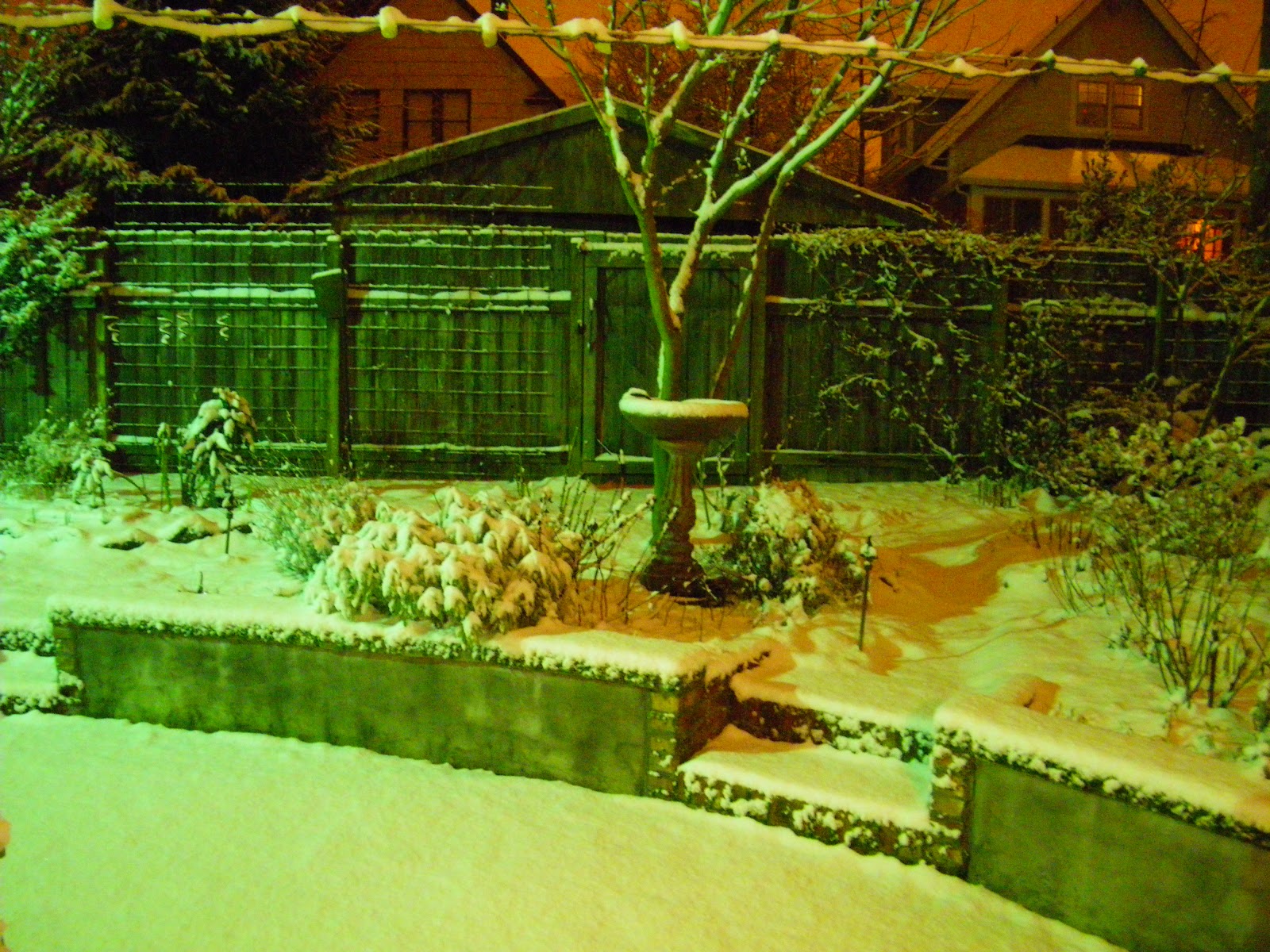
Just a quick post to show you the garden blanketed with last night’s snowfall. This is the perfect kind of snow (in my opinion) here in the lowlands. Here today, gone tomorrow. We got 3-4 inches (7-10cm) in just a few short hours to play in and enjoy but it’ll be all gone by mid-day today. No prolonged freeze to turn it all to ice for days on end, no commuting nightmare, just the fleeting beauty of it. Today’s rain will make short work of it and life will be back to normal. I had to get out before sunrise to snap the pictures before it melted away, it was warming up quickly. The green haze is the glow from our yard light, it doesn’t look that way to us but the camera picked it up.
What’s the weather like in your part of the world?
In Bloom in My Garden Today: no blooms but bulbs are pushing their way up and the Helleborus corsicus and Sarcococca confusa both have buds ready to open.
Authors photos
Tuesday, December 28, 2010
The Potted Garden
"When in these fresh mornings I go into my garden before anyone is awake, I go for the time being into perfect happiness. In this hour divinely fresh and still, the fair face of every flower salutes me with a silent joy. . . . All the cares, perplexities, and griefs of existence, all the burdens of life slip from my shoulders and leave me with the heart of a little child that asks nothing beyond the present moment of innocent bliss."
~ Celia Thaxter, 1835-1894, New England poet and author of An Island Garden
However there are some things to keep in mind if your garden is in pots.
• Water – pots can dry out faster than the ground, so you may be watering more often. You’ll need to dig down into the root area to see if the pot needs watering. Just looking at or touching the soil surface, which dries fastest, is not indicative of what the moisture level is at the roots. There are moisture meter probes available. I haven’t had the greatest success with them but they may be just the thing for you. I just worm my finger down into the soil an inch or two to test for moisture. Hanging pots or moss lined wire pots may need to be watered daily, especially if they are in windy or warm sunny places.
• Good drainage is life or death to potted plants. Roots need oxygen. Oxygen increases as soil dries out and creates air pockets. In the case of most plants if the soil never dries out, even just a little bit, the roots will drown and rot. I do not recommend keeping saucers under pots outside. The saucer will hold water which will wick back up keeping the soil too wet. Remove all saucers and if necessary add ‘pot feet’ under your pots. Pot feet lift the pot up off the ground so water will flow freely out. Depending on the surface your pots are on you may or may not need them. They come in many styles, shapes and sizes. You can buy specialty feet or just use a few bricks or flat stones. Rolling trays allow you to move your pots but if they are solid like a saucer, drill holes in them so you won’t have any sitting water. I find covering the hole with a small square of window screen material before you add the soil works better than stones or pottery chards which can shift and plug up the hole.
• Potting soil – Since I am an organic gardener I buy only potting soils and compost from organic sources. Organic soil companies are tested regularly so you can be sure you are not putting your plants into soil with petrochemicals that will leach out into your surrounding environs or taint your pot of veggies. I do not recommend any bagged soil or compost that has fertilizers added. You don’t know what they are using and the term ‘organic’ is being tossed around too freely and deceptively in the bagged soil industry. Buy your own organic fertilizers from reputable sources and add it yourself depending on the specific needs of the plant(s) in you pot. Potting soil has a neutral ph so if you have a pot for acid loving plants like blueberries, you’ll want to add some spent coffee grounds to raise the acidity level of the soil, and you’ll fertilize with an acid loving plant fertilizer.
• Fertilizer - There is no such thing as one fertilizer fits all. Depending on what you are growing, you’ll want an organic fertilizer that will boost flower and fruiting production, another to boost nitrogen for leaf production. Pots may need fertilizer added more frequently than garden beds because the available nutrients get pulled into the roots or flushed away with watering. Organic fertilizers break down more slowly than chemical fertilizers so you’ll be using a safer ingredient and fertilizing less often. Once in early spring and once in summer are enough for dry organic fertilizers, but synthetics may need to be added monthly or in 6 week intervals.
• The pots themselves – I prefer terracotta or glazed pots. I just like the look of them, but they are really heavy when filled, so they stay where they are. Terracotta can chip and crack. Every winter my terracotta pots show a bit more freeze damage. Some glazed terracotta is marketed as frost proof and will last longer with little or no damage depending on how fierce your winters are. If you need to move your pots, plastic may be perfect for you. Plastic is lighter and easier to move but deteriorates from the sun and becomes brittle over time. If your potted garden has perennials that you want to survive cold winters you’ll need to move them to protected areas. Pots do not provide the insulation from freezing to the root zone like ground soils.
• Moving pots - even if you don’t plan to move your pots, there are times it seems it must be done. If you are not Ms/Mr. Brawny, don’t happen to have a Mr. Brawny nearby, or are too impatient to wait for him to get his act together, treat yourself to a handy hand truck. Mine is small but has a 300 pound capacity. Try to find one with bowed support rungs in the back so your pot doesn’t go sliding off as you round a corner. You may want to strap your pot to it for better security. I wouldn’t get one with inflatable tires either, they always seem to be flat when you need it most. Solid, hard rubber tires or the like are fine, and the bigger the better if you have to go over bumpy ground.
For the sake of keeping this post from being pages and pages long I’ve not elaborated too much on several points. If I’ve left you with unanswered questions, please drop me a line in comments so we can chat more. Or take your questions to your local nursery where they will have pot feet and fertilizers and what you need to have an awesome potted garden.
May your garden be one of many sanctuaries of rest for you as mine is for me.
In Bloom In My Garden Today: sadly nothing to report
Author’s photo
~ Celia Thaxter, 1835-1894, New England poet and author of An Island Garden
The quote from Celia Thaxter above is one reason why I love gardening so. Years ago, at a particularly difficult time in my life, I stepped out my back door to begin yet another emotionally dark day. My burdens were too heavy. As I turned from the door toward the garage I heard my bubbling fountain, which caused me to look up. I hadn’t been looking up enough. I saw the sun was shining and my garden was there…in all it’s restful beauty. For a brief moment I stood there, looking and listening to the sounds of my garden and some of the burden slipped off my shoulders. I so needed that in that moment.
Everyone can experience that peace from a garden, whether it’s their own garden or a municipal garden or a park to visit. You don’t have to have acres of land or a big yard to have a garden. Many a garden is made up of pots. Big pots, small pots, lots of pots or just a few pots. The potted garden is just the thing if you are limited on time (far less weeding), space (think of balcony gardens), physical ability to reach the ground (easier digging and accessible by wheelchair) and easier to install than raised beds.
However there are some things to keep in mind if your garden is in pots.
• Water – pots can dry out faster than the ground, so you may be watering more often. You’ll need to dig down into the root area to see if the pot needs watering. Just looking at or touching the soil surface, which dries fastest, is not indicative of what the moisture level is at the roots. There are moisture meter probes available. I haven’t had the greatest success with them but they may be just the thing for you. I just worm my finger down into the soil an inch or two to test for moisture. Hanging pots or moss lined wire pots may need to be watered daily, especially if they are in windy or warm sunny places.
• Good drainage is life or death to potted plants. Roots need oxygen. Oxygen increases as soil dries out and creates air pockets. In the case of most plants if the soil never dries out, even just a little bit, the roots will drown and rot. I do not recommend keeping saucers under pots outside. The saucer will hold water which will wick back up keeping the soil too wet. Remove all saucers and if necessary add ‘pot feet’ under your pots. Pot feet lift the pot up off the ground so water will flow freely out. Depending on the surface your pots are on you may or may not need them. They come in many styles, shapes and sizes. You can buy specialty feet or just use a few bricks or flat stones. Rolling trays allow you to move your pots but if they are solid like a saucer, drill holes in them so you won’t have any sitting water. I find covering the hole with a small square of window screen material before you add the soil works better than stones or pottery chards which can shift and plug up the hole.
• Potting soil – Since I am an organic gardener I buy only potting soils and compost from organic sources. Organic soil companies are tested regularly so you can be sure you are not putting your plants into soil with petrochemicals that will leach out into your surrounding environs or taint your pot of veggies. I do not recommend any bagged soil or compost that has fertilizers added. You don’t know what they are using and the term ‘organic’ is being tossed around too freely and deceptively in the bagged soil industry. Buy your own organic fertilizers from reputable sources and add it yourself depending on the specific needs of the plant(s) in you pot. Potting soil has a neutral ph so if you have a pot for acid loving plants like blueberries, you’ll want to add some spent coffee grounds to raise the acidity level of the soil, and you’ll fertilize with an acid loving plant fertilizer.
• Fertilizer - There is no such thing as one fertilizer fits all. Depending on what you are growing, you’ll want an organic fertilizer that will boost flower and fruiting production, another to boost nitrogen for leaf production. Pots may need fertilizer added more frequently than garden beds because the available nutrients get pulled into the roots or flushed away with watering. Organic fertilizers break down more slowly than chemical fertilizers so you’ll be using a safer ingredient and fertilizing less often. Once in early spring and once in summer are enough for dry organic fertilizers, but synthetics may need to be added monthly or in 6 week intervals.
• The pots themselves – I prefer terracotta or glazed pots. I just like the look of them, but they are really heavy when filled, so they stay where they are. Terracotta can chip and crack. Every winter my terracotta pots show a bit more freeze damage. Some glazed terracotta is marketed as frost proof and will last longer with little or no damage depending on how fierce your winters are. If you need to move your pots, plastic may be perfect for you. Plastic is lighter and easier to move but deteriorates from the sun and becomes brittle over time. If your potted garden has perennials that you want to survive cold winters you’ll need to move them to protected areas. Pots do not provide the insulation from freezing to the root zone like ground soils.
May your garden be one of many sanctuaries of rest for you as mine is for me.
In Bloom In My Garden Today: sadly nothing to report
Author’s photo
Friday, December 24, 2010
Christmas Cheer
~ Thomas Cooper, American scientist and patriot, 1759-1839
This year’s winter bouquet is far more simple than last year's. Two weeks ago we had fierce winds so there were lots of downed limbs for me to choose from. I gathered Douglas Fir and Cedar for the backdrop. In the center I put stems of Skimmia japonica which I cut from the garden. It is in bud and the bud’s stems are reddish, giving the color. A collar of gathered silvery lichen finishes off the base. I had some red orbs to add to it but in the end I liked it much better without them. There’s beauty in the simplicity this time I think.
As the year draws to a close, I think of all of you who visited me this year. Thank you very much for supporting my blog. I hope it has inspired you in some way and I look forward to spending more time with you next year. Until then…Merry Christmas to you all.
May His love and presence fill you to overflowing and bring you a most joyous Christmas and a wonderful new year!
In Bloom In My Garden Today: sadly none to report
Author’s photo
Friday, December 17, 2010
Garden Companions
“A true friend can multiply your joy and divide your sorrow.”
~Bruce Bickle and Stan Jantz
What a day, what a day! It was a gorgeous day to be in the garden on Monday. The buckets of rain ended but the unseasonably warm temperatures from the tropical jet stream that remained lured me out. It felt like March! First I went for a long walk, soaking up the sun. Then I brought my orchids out for a thorough cleanup and repotting, a messy job I’d rather do outside than in. A bit of sweeping and trimming needed to be done as well, and it was then I noticed bulbs pushing their way up. I saw the green tips of crocus, colchicum, and daffodils.
While the birds were singing and flitting about, I got to thinking of all the garden companions I’ve had visit this year. I’m never alone when I’m in my garden. Here’s a few of the many friends that kept company with me this year.
Now the rain has returned but for the morning at least the bees were flying and happy, birds were singing and happy, cat was galloping around and happy and I was happy. Now the orchids are happy. What a day!
In Bloom In My Garden Today: Primrose, Daphne 'Eternal Fragrance' and 'Summer Ice'
Some photos courtesy of Pat Chissus
The rest are authors photos
~Bruce Bickle and Stan Jantz
What a day, what a day! It was a gorgeous day to be in the garden on Monday. The buckets of rain ended but the unseasonably warm temperatures from the tropical jet stream that remained lured me out. It felt like March! First I went for a long walk, soaking up the sun. Then I brought my orchids out for a thorough cleanup and repotting, a messy job I’d rather do outside than in. A bit of sweeping and trimming needed to be done as well, and it was then I noticed bulbs pushing their way up. I saw the green tips of crocus, colchicum, and daffodils.
While the birds were singing and flitting about, I got to thinking of all the garden companions I’ve had visit this year. I’m never alone when I’m in my garden. Here’s a few of the many friends that kept company with me this year.
In Bloom In My Garden Today: Primrose, Daphne 'Eternal Fragrance' and 'Summer Ice'
Some photos courtesy of Pat Chissus
The rest are authors photos
Wednesday, December 8, 2010
Winter's All-You-Can-Eat Buffet
Feed the birds, Tuppence a bag…
~Mary Poppins
Just in case you need any more reasons not to do big-time fall cleanup in your garden, perhaps this will do.
I looked out my kitchen window and saw this song sparrow, feasting on the delectable seeds left on the seed head of the Echinacea that I didn’t cut down in fall. Do you see the cone behind it just to the right? Every seed is completely devoured, leaving only the core, which I will compost in the spring when I do my garden cleanup.
A delightful sight I wouldn’t want to miss! Juncos and Chickadees also partake of the Echinacea seeds left on the stalk as well as the plant just to its left. That Caryopteris is also full of seeds which these birds feed on all winter and leaving the branching structure intact can also provide roosting shelter during storms. The untidy winter garden is a veritable smorgasbord for the birds. Keep them coming in the winter and they will come in the spring and summer to get those bugs that bug you.
In Bloom In My Garden Today: Daphne caucasica ‘Eternal Fragrance’ and ‘Summer Ice’ are both eking out a few new blossoms.
Author’s photo
Subscribe to:
Posts (Atom)