Showing posts with label hummingbirds. Show all posts

Friday, February 7, 2025

Winter Flowering Hellebore - Perspective is Everything


Last night, there came a frost, which has done great damage to my garden.... It is sad that Nature will play such tricks on us poor mortals, inviting us with sunny smiles to confide in her, and then, when we are entirely within her power, striking us to the heart.  ~Nathaniel Hawthorne


In my line of work, every year when the hellebores emerge their beautiful flowers, I hear of discontent from folks who despair of the downward facing flowers as if it were a flaw of nature.

I put it to you that this is not "a problem" but a purpose.

The stems are not weak, as some would suppose they are. The stems are delicate yet strong. They bend not because they can't bear the heavy weight of the flower, but turn purposely to point the flower down so to protect the precious pollen and nectar from the elements by the petals enveloping them. At the very curve, the extra strengthening tissue encircling the stem can often be seen. It is strength in the bend, not a floppy weakness. It stabilizes the flower in its perfect, protective position.


You will see this protective habit with many winter flowering species, a few being snowdrops, some early flowering species tulips, and some early jonquils.


Hybridizing has tried to "correct" the downfacing flower in some cultivars making them less useful to wildlife, for the pollen and nectar can become spoiled when exposed in winter’s volatile weather patterns.

Why not the crocus?
Crocus close themselves in adverse weather and at night when no insects will be looking for the pollen and nectar.  They open again in the sun when the insects are foraging.
Up facing species tulips will open and close with the weather as well.


Purpose, not problem.

To truly enjoy the beauty of nature, I look for purpose in the design.
It is infinitely more satisfying than focusing on a perceived negative trait that you don't understand, don't you agree?

 In Bloom In My Garden Today: (prior to a deep freeze 5 days ago) hellebore, primrose, geum, sarcococca, galanthus

Saturday, January 30, 2021

Embracing Wildlife

 "If we can teach people about wildlife, they will be touched. Share my wildlife with me. Because humans want to save things that they love." 

~ Steve Irwin


Yay! I am certified!

Embracing wildlife in the garden brings innumerable rewards. Creating wildlife-friendly plantings is how we do it.  Consider what comes into your yard already. Do you want them to keep coming?  Do you want something that you don’t see?

It’s simple really. Animals and insects need food, water and shelter just like you and me. Incorporate plants that will attract what you want to see more of into your garden spaces.

When buying plants for your garden, many plant labels give some wildlife information that can help you make your choices. The most common symbols I see on labels are for attracting butterflies, pollinators and hummingbirds and for deterring rabbits and deer.

 Firstly, water. Be sure to add a fresh water source or two to your garden for them to drink and/or bathe in. And remember to keep the water fresh and its container clean. You may need to hose it out and refill it daily depending on its popularity. Be sure to locate your water container where you can see it often, every day. You will be rewarded by seeing the wildlife that comes to it.

 Thrush at the fountain.


 Robin at the water bowl.

It doesn’t have to be elaborate. This (above) water bowl is just a saucer that is sold for catching water under pots.

If you have cats or dogs that visit your garden, I would suggest not putting a water source this low to the ground. You can raise it up on a tall stump or a stack of bricks or concrete blocks. Safety to the wildlife is key in enjoying them in your garden.

The depth of the water will attract different size birds for bathing. Shallow bowls will attract smaller songbirds while deeper water will be easier for large birds to bathe in. And hummingbirds love flitting through a mist, so a pump with spray may be in order for you.

 As for shelter, birds not only use birdhouses for rearing their young in the spring and summer, they can also use it for shelter during winter storms. 

Be sure to keep them mounted at an accessible height for you but out of reach for cats. I do clean the bird houses out late each winter before birds actively begin searching for a place to nest. A couple of times there were unhatched eggs that had rotted or babies inside that had died. It needed to be cleaned out or new lodgers would not have come, I think.

Lastly is the topic of feed. Best, first and foremost, are plants that offer natural food sources like nectar, pollen and berries all throughout the year, not just summer. In the two photos below, honeybees are gathering pollen or nectar to take back to their hive.

 Honey bee on Helianthus ‘Lemon Queen’

 Honeybee on Verbascum chaxii ‘Album’

When you attract insects, don’t begrudge them taking advantage of your plants for their needs other than food. In the next photo, this is not damage in my opinion. This is evidence of the leaf cutter bee.


They cut out perfect circles in soft leaves. They then fly back with the disc to use as packing material for its tubular nest to protect the larvae till ready to hatch. I welcome these holes and smile every year when I see leaf cutter bees are active in my garden. If you happen to see one in the very act of leaf cutting, you are very lucky indeed. It is fun to watch. Leaf cutter bees are passive and one of the many native pollinators here in the U.S. We need them.

 Food supplementation is not without controversy, but I do believe it has a legitimate place in the wildlife friendly garden. If your garden does not offer winter food sources naturally, you may consider feeding.

Suet for bird feeding is a debated form of feed, but I do offer it during all the cold, rainy months.


Winter winds drive winter’s rain into seed feeders of all types in my experience. Soggy seed feeders are a mess to keep clean and molded seed is hazardous to your feathered visitors. I choose to feed suet because it is not affected by rain, it is consumed quickly and many species of birds come to it.

The hummingbirds will find nectar in a very large variety of flowers.

Commonly they are seen sipping from the plants with more tubular shaped flowers like penstemon, salvia and fuchsia.  However, I have also seen them on roses, and in the winter months they visit my Camelia ‘Yuletide’ which is not tubular, yet attractive to them by its red flowers and nectar stores.

 Here a green Anna’s hummingbird enjoying nectar from flowers on the right hand side of this pot of fuchsia plants.


If you feed them with a syrup mixture, it is not recommended to use that red dye stuff you buy at the store in a box. It contains a red chemical dye which is toxic for people and birds alike. The red plastic tops and tubes on feeders are enough to catch the hummingbird’s attention.


A simple syrup you make yourself with equal parts table sugar and boiling water, dissolved and cooled is better for them. Frankly they will find your offering with no color on the feeder at all but if you want red, buy one that has red parts. Or you could hang it with a red ribbon, tie on a red flower or use a red ‘write-on-glass’ pen to add some color to the glass bottle.

In reality, hummingbirds also feed on lots of flowers that are not red. While the color is attractive to them, it is not critical. Once they find your syrup feeder, they will be back as long as you keep it clean and filled. Give it a good wash out with a bottle brush before each refill. Check it weekly if not more often. Sugar water can mold quickly especially if in a sunny location. Shade is a more desirable choice. Depending on traffic, be prepared to fill it weekly or every couple of days.

You may find suggestions online for various syrup recipe ratios based on seasonal changes. Honestly, I used to do that but don’t anymore. They come year-round to my feeder with the same 1:1 water/sugar ratio recipe.

Feeding deer or rabbit is another matter. Plant tags with a slash through an image of deer or rabbit signifies plants that neither will tend to eat. If you have a lot of foraging deer in your vicinity, don’t plant roses or other plants they are known to devour. Personally, I would rather have the occasional deer wander through my yard instead of a lot of roses.

Don’t get me wrong. I like roses and have had many over the years. In my previous garden I had 3 Old English roses in the back yard where the deer didn’t go.

There are two roses in this garden that have been here for a very long time judging by the size of the older canes. This guy nibbles a few blossoms each time he comes by but he doesn’t devour the whole plant.


I will keep the roses for the time being. I don’t really like where they are planted nor do I know what kind they are, but they bloom all summer and well into the winter, don’t require extra summer watering or fertilizer and must not be like candy to the deer, like most fussy hybrid teas roses are.

Apparently, deer like fuchsias too. I see hoof prints often in my garden after one or more has been by the night before. Other than hoof prints the only evidence of browsing I have seen was that he ate all the top blossoms off this big pot of fuchsias pictured above. I don’t mind. I love seeing deer and we are not overrun with herds of them where I live and garden. They left enough flowers for me and hummingbird to enjoy too.

Deer are foraging wildlife. When food is abundant they will be choosy. When food is scarce they will be less so. Understanding this, there are many lists of deer resistant plants any internet search will provide you with, as well as symbols on plant lables, but accept the fact that when food is scarce they will eat even that which they may not prefer. They don’t read those lists. The lists are simply guides for you and me based on someone elses previous experience.

As for bunnies, we had tons of them in the spring. They nibbled a few low-to-the-ground flowers on the veronica but I didn’t mind at all.  Mostly they just ate the soft fresh leaves of the clover, dandelion and grass. I always leave clover in the grass anyway. It feeds nectar to bees and pollinators and clover root fixes nitrogen in the soil which feeds the grass. I have enjoyed seeing bunnies come by as part of my local wildlife mix too and don’t mind their nibbling on some of the plants. There’s enough to go around for us all to enjoy.

There is so much more I could write on this subject, but hopefully this is enough to whet your appetite for ideas if you want to create a wildlife friendly garden.

Here in the USA, many states have a backyard sanctuary program. The signage in the first photo proves my certification based on the requirements of the Washington Department of Fish and Wildlife. If where you live has such a program, I encourage you look into the certification requirements. The signage sparks interest and conversation and maybe more wildlife friendly gardens will grow.

Thanks for reading and happy gardening!


In bloom in my garden today: Geum, Camellia ‘Yuletide’, Primrose, Calendula, Erica carnea winter heath, Lithodora, Erysimum (wallflower)

Bird photos courtesy of Patrick L. Chissus photography. You can see more of his work on Instagram @nwmaritimephotography

All other photos are mine.

Saturday, September 12, 2020

In the Hot Bed


Gardening requires lots of water – most of it in the form of perspiration. 

~Lou Erickson

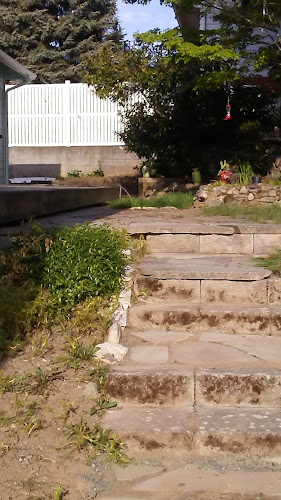
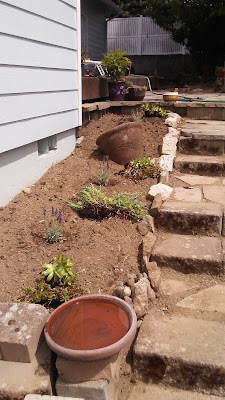
There is a set of stairs at the back of the house dividing the sloped south facing yard into two terraced levels. This is how the beds on both sides of the stairs looked in April when we moved in. The post today is only about the left side, which is up against the foundation of the house and south facing, so it is hot and dry.


My first thoughts were that lavender and sedums would be perfect plants for this area. Once established (after next year) they wouldn’t require a lot of watering as both thrive in hot dryish areas with all day sun, and they would provide food for bees, hummingbirds and other pollinators.


The only plants in that bed, aside from weeds, was a vinca tangled up with a Euonymus. The bed is just shy of 3 feet wide and 10 feet long.

Vinca is a vining, far reaching ground cover that is very ineffective at smothering out weeds and it will have to be constantly cut back if it isn’t to interfere with the walkway. It’s out.

The Euonymus is, to my taste, an uninteresting shrub that can reach out 4-6 feet wide and even taller. In this location it too would have to be pruned annually once it reached its mature size. And it would block the view of the garden I planned to create on the other side of the walk. Out it goes too.

The bed was bordered with rocks on the stair edge, presumably to stop the dirt from spilling out onto the stairs. As you can see over time the lower rocks became buried and weren’t doing the job. Lastly, there was a makeshift retaining wall made of mis-matched blocks at the bottom of the bed which had collapsed. Sorry, I didn't get a good photo of that.


All cleared away, now I have a blank slate to work with. First in goes 3 lavenders. “Goodwin Creek” to be specific. I have grown this one before and it is a favorite of mine. I love the indented leaf shape and it puts up long willowy wands of blooms which create lovely movement in the breeze. It also had a longer bloom time in my previous garden than other lavenders. It is a lovely variety. 

Along with the lavender, I added a broken portion of a Mexican pottery pot. I like using broken pots as a little interest, or whole pots turned on their side and angled just so. A little eye candy if you will.


After the lavenders are placed as the “bones” of the space, I filled in with sedums of many varieties from trailing types to hen’s and chicks types, all of which came with me from my previous garden. Sedums are incredibly easy to propagate. They will spread and fill in quickly.

As for the lost rocks edging the lowest steps, I pulled them up and re positioned them. I don’t really like rocks used that way but for now they will stay.


If all that isn’t exciting enough, now the icing on the cake happens! This is where my better half comes into his own. He is so creative and talented when it comes to hardscaping our garden spaces. He set about making a beautiful retaining wall to support the end of this bed. He used concrete blocks and capped them with flat stones. The blocks and stones had been left, stashed and buried in different places in this yard, by past owners.


First, he carved out the shape, and poured a footing in concrete.


Then cemented together blocks.


Then he ‘faced’ the blocks with a rough smear of mortar. 

He adds color powder to the mortar to give an aged look to his stucco finish. New concrete dries bright whitish and isn’t particularly lovely. The new brightness can be distracting in the garden, I think. Concrete does darken over time but it takes years. He ‘ages’ it by darkening it with coloring agents so the new wall looks like it’s been there for a long time and it blends better in the garden. I love the rough look of a stucco finish. It transports me to Tuscany or south of the border.


Then he capped it all off with some slate or what ever this stone is. There were several pieces of this stone laying around, apparently left-overs from the construction of the patio some years ago. I am so glad to have them as they are just perfect to finish this wall.


So… what do you think? Coming along nicely, I think. In a year or two you won’t see much, if any, soil after these plants fill in. Covered soil means less weeds. Win Win.

Cheers!

In Bloom in my Garden Today: Rose, Sedum, Agastache, Geum, Fuchsia, Salvia, Verbena, Gladiolus, Mullen, Thyme, Oregano, Calendula, Yarrow, Dianthus, Germander, Cuphea,

Author’s photos

Tuesday, January 2, 2018

Feeding Wildlife in Winter

Squirrel, squirrel, burning bright,
Do not eat my bulbs tonight!
I think it bad and quite insidious
That you should eat my blue tigridias.
~author unknown

If you take some time in considering your local wildlife as you plan your garden, you may be able to stop some of the destructive munching that goes on as they wander through by supplying them with a few natural food sources.

In my part of the world, the pesky Eastern gray squirrel can be really obnoxious as they try to get to my birdseed feeders. I have found feeders knocked to the ground and emptied or the squirrels have chewed both plastic and wooden feeders apart to get the seed inside. Strategic placement of birdseed feeders is key as is a metal “slinky” to keep them from climbing up the post.


 Yes, it really works.

Indeed, I pat myself on the back when I can actually outsmart them, and I am equally happy to see them turn their attention to my natural offerings. This happy guy is munching on the seeds still hanging on the Winter Hazel (Corylopsis veitchiana). If the seeds of the Winter Hazel fall to the ground they will sprout in the spring, so if the squirrel eats them in winter that means less spring weeding for me. Winner!


Squirrels also enjoy the berries of the Solanum crispum blue flowering potato vine.


And rose hips! I have seen both squirrels and birds feasting on the tiny hips of this rose during the winter months.


The pyracantha berry is delectable to many birds including robin, varied thrush and starling. I also see the sweet little Bewicks wren flitting throughout its evergreen leaves. I’m not sure if they nibble on the berries but I know they are feasting on bugs.


The beautiful flowers of the Mahonia provide winter nectar to hummingbirds. I have the low growing variety “Soft Caress” with it’s gorgeous palm leaf like foliage. It is mostly done flowering now and at only 12 inches tall, it’s hard to see if any hummers are actually going to it.


I have seen them on a neighbors much taller variety that is at the height of its bloom right now. I don’t know for sure but from the looks of it I believe it could be Mahonia “Charity”.


I do put out suet cakes, Black oil sunflower seed and Niger thistle seed in hanging feeders. I want to attract the birds in winter as much as I do in spring and summer. Not only because I love the joy they share in their song and flight but also because I am an organic gardener, therefore I have bugs that I want them to eat. That is what integrated pest management (IPM) is all about. Less use of harmful chemical sprays, more nourishment as nature intended it.

Cheers and thanks for reading!

In Bloom in My Garden Today: Mahonia, Primrose, Rosa “Reine de Violette”

Author’s photos

Friday, May 15, 2015

Book Review - A Picture Cyclopedia of Flowers

Garden writing is often very tame, a real waste when you think how opinionated, inquisitive, irreverent and lascivious gardeners themselves tend to be.  Nobody talks much about the muscular limbs, dark, swollen buds, strip-tease trees and unholy beauty that have made us all slaves of the Goddess Flora.  ~Ketzel Levine

Do you collect gardening books?

I don’t collect them per say, but I do keep a small library of my most favorite go-to books when I need extra info on a perennial or a particular veggie’s habit. Now and then I find garden writing books at used book stores, read them then sell them back if they are good but not keepers. I do check out some from the library too, by fun to read authors like Beverley Nichols and Ann Lovejoy. I wish Mike McGrath would write more books…his humor never disappoints and always produces belly-laughs from deep within my own experiences. Maybe one day some genius will compile his newspaper columns into a book. I’d buy it for sure. I have Christopher Lloyd’s cyclopedia with pages and pages of his opinionated thoughts on plants. I love it. It is great for information and a chuckle or two as he shares his experiences in the garden.


So the other day was a beautiful day in May.  We went on a walk and found the first of the summer’s yard sales were set up. As usual we scrutinized the goods as we ever so slowly walked by. We certainly don’t need more stuff but I can never resist a look-see. One in particular had a bunch of books out for sale. Lo and behold I found a gardening book so I picked it up and started leafing through. Written in 1933 (how cool is that?) it had beautiful hand colored photographs and some illustrations for every flower and plant detailed within its pages.

Reading old gardening books is a little like old science books….things change. New discoveries are made and botanical nomenclature changes as plants are reclassified by who-knows-who, rendering them inaccurate, but I thought one can always learn new things, even if they are outdated, right? So…well, it was just a dollar after all…so…I bought it. It would be nice to have for the gorgeous old time photos alone.

It is titled Garden Flowers in Color. A Picture Cyclopedia of Flowers by G. A. Stevens.

Once home again and comfortably flopped down on my chaise lounge, I read the introduction. The author states, and I quote “The text has been prepared with as much fidelity to the floral facts as that provided in the illustrations. It has been written, for the most part, from actual garden acquaintance with the wide range of subjects covered in these pages and it is believed that a book of definite educational value as well as a convenient adjunct has resulted” end quote.

Ok, so that said I commence perusal. Wow, lots of varieties back then that just aren’t seen these days. Educational and fun but not particularly helpful for researching today’s cultivars.

Hmmm, Funkia…the apparently old fashioned term for Hosta. Cool…I do have elderly customers at work asking for plants in terms we don’t use these days…this may be really helpful! Matter of fact one of our customers is 100 years old!! Scouts honor! I’ll have to ask her if she knows the term Funkia.

On and on I read, mostly it is indeed factual stuff…till I get to page 225. Rose Acacia. "Professionally known as Robinia hispida or Pink Locust." We sell Purple Robe Locust where I work and it is truly a beautiful flowering tree, but I’ve never grown one myself. Reading the description…”Robinia hispida is the botanical name of the Pink Locust, which gardeners for some reason or other have decided to call Rose Acacia. It is a clammy shrub, usually grafted on the top of a tall waking stick and stuck in the most conspicuous place in the garden. The flowers are obese and ugly, and they hang in sticky profusion from the foliage. It is a most unattractive thing without beauty or merit as a garden plant.”


Wait…what? But G. A., on page 7 you said your writing was prepared…”with as much fidelity to the floral facts…” Hmmm. Apparently this excerpt is more closely associated with the “actual garden acquaintance” you mention later. Ok, really, I have to ask…what in the world does “a clammy shrub” describe?

Well the rancor fun doesn't stop there. Weigelas don’t escape the author’s verbal lashing either…oh no my friends, read on...


“Among the commoner shrubs for ordinary purposes are the humble Weigelas. Great, rank bushes they are, with coarse foliage and still coarser and uglier flowers….But one of the most dreadful shrubs which have ever been foisted upon a defenseless nation is the supremely ugly variety called Eva Rathke. No one can imagine how hideous a flower can be until one of these monstrosities is brought to his attention. In fact the blight of Eva Rathke rests upon all Weigelas and no garden would suffer if all the Weigelas in the world were piled high and dry and burned to ashes.”

Oh dear, oh dear. A tad harsh? I've had Weigela. Mine was a lovely graceful variegated shrub with soft pink blooms much enjoyed by hummingbirds. Quite nice actually, er…in my humble opinion.

And who said gardeners were opinionated?

In Bloom in My Garden Today: Alyssum, Bergenia ‘winter glow’, Blueberry, Brunnera, chive, Daphne caucasica ‘Eternal Fragrance’, Dianthus deltoides ‘Flashing Lights’,Exbury azalea, Fuchsia, Geranium phaeum ‘lily lovell’ (mourning widow), Geum, Heuchera, Iris, Kniphofia ‘little maid’, Nepeta ‘six hills giant’ (catmint), Oxalis oregana ‘wintergreen’, Peony, Phygelius, Pyracantha koidzumii ‘victory’, Rose, Rhododendron, Sage, Saxifraga andrewsii (irish saxifrage), Schisandra rubriflora (strawberry vine), Tellima grandiflora (fringecup), Trillium,Vancouveria hexandra (inside out flower), Tomato

Authors photos

Saturday, January 31, 2015

Winter Fragrance


Give me odorous at sunrise a garden of beautiful flowers where I can walk undisturbed.  ~Walt Whitman


It’s January, and winter is in full swing up here in the northern hemisphere. Which means every time I step out my back door I am greeted, nay assailed by the heady fragrance of my Sarcoccoa confusa bush. This evergreen delight is planted near my front door, but the scent wafts completely around the house on the air currents to perfume my back yard too. Follow this link to my previously published work for its particulars.

As I walk around my city’s neighborhoods I find it everywhere by following the fragrance as it ebbs and flows across my path. It is in full bloom now and will soon be followed by Daphne odora (Winter Daphne), then after that Skimmia japonica, all of which will keep you in a sweet-scented state of enchantment through March.

So here’s a heads up…if you live in the Pacific Northwest, get to your local nursery now. Sarcoccoa will be blooming and for sale, ready and waiting to be added to your garden.

Oh, and a BONUS! Hummingbirds sip of it's nectar daily and honey bees take full advantage of its pollen and nectar offerings when the temperatures are mild. I see both on mine.

In bloom in my garden today: Cyclamen coum (spring), Galanthus elwesii (snow drops), crocus, primrose, Sarcococca confusa, Heath (Erica carnea ‘springwood white’), hellebore

Author’s photo

Thursday, February 14, 2013

Worth The Effort


"An addiction to gardening is not all bad when you consider all the other choices in life."
 ~Cora Lea Bell

It’s a gray, cool day today with a mist ever so slight that it moistens the face but is gone before it hits the ground. The birds are loving it as they are in full force today singing and foraging in the garden. It’s warm enough for the bees to fly too. That’s great news to a Pacific Northwestern beekeeper in February.

I came across this whilst I was out and about today.


Don’t you just love it when you see people taking responsibility for their actions and care for those around them who share the world with them?

I do.

Here are the links
www.beyondpesticides.org
http://www.nwf.org/CertifiedWildlifeHabitat/

In Bloom in My Garden Today: Cyclamen coum, Galanthus elwesii (snowdrops), Heath (Erica carnea ‘springwood white’), Hellebore, Rhododendron, Sarcococca confusa,
 
Authors photo

Wednesday, February 1, 2012

Snow Covered Smorgasbord

I value my garden more for being full of blackbirds than of cherries, and very frankly give them fruit for their songs.
~Joseph Addison (1672 - 1719), 'The Spectator'

Birds need food and water every day, just like us gardeners.
When your very own personal bird sanctuary looks like this…


…most of their natural food sources may have been covered under a blanket of snow or ice encrusted and inaccessible.


That is when I just start tossing loose seed over the snow.


In the winter months I forgo the seed feeders in favor of suet cakes. We have so much rain in winter that the seed often gets wet and molds before the birds eat it all so I put out a few of these instead. This is a flicker, a cousin of a Woodpecker.


Hummingbirds get assistance too.


The Anna’s hummingbird over winters on this side of the Cascade Mountain Range so they are year round in my garden. When the temps dip below freezing for any length of time I make a thicker sugar syrup (with NO red dye ever) and wrap the feeder with 3 or 4 layers of bubble wrap. For the most part the syrup does not freeze, unless we get prolonged temps, day and night in the teens. If that happens I bring it in for the night and put it back out for the day. For our most recent icy blast it was fine and stayed liquefied. I did notice though that the little yellow ‘bee guards’ filled with snow and iced over so I did remove them. They are really only needed in summer months anyway.


Also, when the night temps start to dip below freezing I always put a heater in the birdbath. It has a thermostat so if the temps go above 40 F degrees (4 C) it shuts off. Other wise it keeps the water thawed so they can drink. There are many styles out there but the best I’ve used is the Nelson Blue Devil 200 watt heater. I’ve had it for many years.

Be sure to watch your water levels, as you don’t want the warm steam evaporation to leave your heater high and dry.


These simple measures keep the birds coming all winter to my garden, where they also eat lots of bugs and grubs year round, helping to keep down the pest population. Most of us know that hummingbirds consume nectar, but did you know insects provide the protein in their diet? That’s IPM folks, one of the many simple things that can be done for Integrated Pest Management that can greatly reduce and even eliminate chemical pesticide use and keep our gardens organic.

In Bloom In My Garden Today: Helleborus, Sarcococca confuse, Heather (Erica carnea ‘springwood white’), winter pansies


Author’s photos

Friday, May 6, 2011

Kale for Bees?

Last night, as I was sleeping,
I dreamt — marvelous error!
that I had a beehive here inside my heart.
And the golden bees were making white combs
and sweet honey from my old failures.
~Antonio Machado

So, we attend the meetings of three different bee associations in the region, and at one of them last month a fellow mentioned that he lets his kale go to flower for the bees. Hmmm, I got to thinking, I grow kale, the Tuscan variety (aka Dino kale or Black kale), and usually when it begins to flower I yank it out and start the garden over again. I didn’t know bees would go for it. This spring, if you can call it that, has been so cold and wet for so long that I’ve not been able to get any new seedlings other than peas and leeks in the ground. The garlic and remaining leeks have wintered over well, the asparagus is coming up, the alpine strawberries are blooming and now the kale is in full bloom.


Woo hoo! Not only do the bees love it but the hummingbirds are going for it too! Not in droves but the other day I saw a hummer flitting around and sampling all the flowers. In addition to honey bees and hummingbirds, there were also other different tiny pollinator bees going for it. Check out the honey bee in the picture here. Honey bees have shorter tongues than bumblebees and hummingbirds who could easily reach into such a deep flower. These flowers are a little too tight for the bees to get their heads in far enough for their tongues to reach the nectar so the smart little bee is accessing it from between the petals from the backside of the bloom nearer the stem end. Smart huh?


Who knew?? Not me, that’s for sure but I learned something new that I will continue in the years to come. Leave the kale to bloom for your pollinators.

In Bloom In My Garden Today: Alpine strawberries, Bergenia, Ajuga, Kale, Tulips, Geum, Erythronium ‘pagoda, Fritillaria, Brunnera macrophylla, Anemone nemorosa, Dicenta alba (white bleeding heart), Skimmia, Muscari (Grape Hyacinths), Rhododendron, Mahonia, Clematis, Wood Hyacinths, primrose (double English), Heleborus, Bellis perennis (English daisy),


Author’s photos