Showing posts with label honey bees. Show all posts

Monday, February 24, 2025

The Tommies are up! Crocus tommasinianus

 For gardeners, this is the season of lists and callow hopefulness; hundreds of thousands of bewitched readers are poring over their catalogs, making lists ..., and dreaming their dreams."

-- Katharine White


Tommies, or Crocus tommasinianus are considered the most squirrel-resistant species of crocus because this species contains a bitter-tasting alkaloid that repels squirrels. Bonus... they re-seed freely for naturalizing! Win! Win!

They are early bloomers and adorable in the weakest of lawns but don't mow until after the leaves have died back, about 6-8 weeks after bloom fade. Those leaves are making food for next years flowers. Thick, fertilized, lush lawns can overwhelm them, so enjoy them in your garden beds instead.

Be sure to plant them in sunny sites. They'll open on sunny days giving a much needed early pollen source to bees.

Tommies, Crocus tommasinianus - look for them.

In Bloom in My Garden Today: Crocus, Galanthus, Cyclamen coum, Sarcococca, Erica 'Kramer's Rote', Helleborus


Friday, February 7, 2025

Winter Flowering Hellebore - Perspective is Everything


Last night, there came a frost, which has done great damage to my garden.... It is sad that Nature will play such tricks on us poor mortals, inviting us with sunny smiles to confide in her, and then, when we are entirely within her power, striking us to the heart.  ~Nathaniel Hawthorne


In my line of work, every year when the hellebores emerge their beautiful flowers, I hear of discontent from folks who despair of the downward facing flowers as if it were a flaw of nature.

I put it to you that this is not "a problem" but a purpose.

The stems are not weak, as some would suppose they are. The stems are delicate yet strong. They bend not because they can't bear the heavy weight of the flower, but turn purposely to point the flower down so to protect the precious pollen and nectar from the elements by the petals enveloping them. At the very curve, the extra strengthening tissue encircling the stem can often be seen. It is strength in the bend, not a floppy weakness. It stabilizes the flower in its perfect, protective position.


You will see this protective habit with many winter flowering species, a few being snowdrops, some early flowering species tulips, and some early jonquils.


Hybridizing has tried to "correct" the downfacing flower in some cultivars making them less useful to wildlife, for the pollen and nectar can become spoiled when exposed in winter’s volatile weather patterns.

Why not the crocus?
Crocus close themselves in adverse weather and at night when no insects will be looking for the pollen and nectar.  They open again in the sun when the insects are foraging.
Up facing species tulips will open and close with the weather as well.


Purpose, not problem.

To truly enjoy the beauty of nature, I look for purpose in the design.
It is infinitely more satisfying than focusing on a perceived negative trait that you don't understand, don't you agree?

 In Bloom In My Garden Today: (prior to a deep freeze 5 days ago) hellebore, primrose, geum, sarcococca, galanthus

Saturday, January 30, 2021

Embracing Wildlife

 "If we can teach people about wildlife, they will be touched. Share my wildlife with me. Because humans want to save things that they love." 

~ Steve Irwin


Yay! I am certified!

Embracing wildlife in the garden brings innumerable rewards. Creating wildlife-friendly plantings is how we do it.  Consider what comes into your yard already. Do you want them to keep coming?  Do you want something that you don’t see?

It’s simple really. Animals and insects need food, water and shelter just like you and me. Incorporate plants that will attract what you want to see more of into your garden spaces.

When buying plants for your garden, many plant labels give some wildlife information that can help you make your choices. The most common symbols I see on labels are for attracting butterflies, pollinators and hummingbirds and for deterring rabbits and deer.

 Firstly, water. Be sure to add a fresh water source or two to your garden for them to drink and/or bathe in. And remember to keep the water fresh and its container clean. You may need to hose it out and refill it daily depending on its popularity. Be sure to locate your water container where you can see it often, every day. You will be rewarded by seeing the wildlife that comes to it.

 Thrush at the fountain.


 Robin at the water bowl.

It doesn’t have to be elaborate. This (above) water bowl is just a saucer that is sold for catching water under pots.

If you have cats or dogs that visit your garden, I would suggest not putting a water source this low to the ground. You can raise it up on a tall stump or a stack of bricks or concrete blocks. Safety to the wildlife is key in enjoying them in your garden.

The depth of the water will attract different size birds for bathing. Shallow bowls will attract smaller songbirds while deeper water will be easier for large birds to bathe in. And hummingbirds love flitting through a mist, so a pump with spray may be in order for you.

 As for shelter, birds not only use birdhouses for rearing their young in the spring and summer, they can also use it for shelter during winter storms. 

Be sure to keep them mounted at an accessible height for you but out of reach for cats. I do clean the bird houses out late each winter before birds actively begin searching for a place to nest. A couple of times there were unhatched eggs that had rotted or babies inside that had died. It needed to be cleaned out or new lodgers would not have come, I think.

Lastly is the topic of feed. Best, first and foremost, are plants that offer natural food sources like nectar, pollen and berries all throughout the year, not just summer. In the two photos below, honeybees are gathering pollen or nectar to take back to their hive.

 Honey bee on Helianthus ‘Lemon Queen’

 Honeybee on Verbascum chaxii ‘Album’

When you attract insects, don’t begrudge them taking advantage of your plants for their needs other than food. In the next photo, this is not damage in my opinion. This is evidence of the leaf cutter bee.


They cut out perfect circles in soft leaves. They then fly back with the disc to use as packing material for its tubular nest to protect the larvae till ready to hatch. I welcome these holes and smile every year when I see leaf cutter bees are active in my garden. If you happen to see one in the very act of leaf cutting, you are very lucky indeed. It is fun to watch. Leaf cutter bees are passive and one of the many native pollinators here in the U.S. We need them.

 Food supplementation is not without controversy, but I do believe it has a legitimate place in the wildlife friendly garden. If your garden does not offer winter food sources naturally, you may consider feeding.

Suet for bird feeding is a debated form of feed, but I do offer it during all the cold, rainy months.


Winter winds drive winter’s rain into seed feeders of all types in my experience. Soggy seed feeders are a mess to keep clean and molded seed is hazardous to your feathered visitors. I choose to feed suet because it is not affected by rain, it is consumed quickly and many species of birds come to it.

The hummingbirds will find nectar in a very large variety of flowers.

Commonly they are seen sipping from the plants with more tubular shaped flowers like penstemon, salvia and fuchsia.  However, I have also seen them on roses, and in the winter months they visit my Camelia ‘Yuletide’ which is not tubular, yet attractive to them by its red flowers and nectar stores.

 Here a green Anna’s hummingbird enjoying nectar from flowers on the right hand side of this pot of fuchsia plants.


If you feed them with a syrup mixture, it is not recommended to use that red dye stuff you buy at the store in a box. It contains a red chemical dye which is toxic for people and birds alike. The red plastic tops and tubes on feeders are enough to catch the hummingbird’s attention.


A simple syrup you make yourself with equal parts table sugar and boiling water, dissolved and cooled is better for them. Frankly they will find your offering with no color on the feeder at all but if you want red, buy one that has red parts. Or you could hang it with a red ribbon, tie on a red flower or use a red ‘write-on-glass’ pen to add some color to the glass bottle.

In reality, hummingbirds also feed on lots of flowers that are not red. While the color is attractive to them, it is not critical. Once they find your syrup feeder, they will be back as long as you keep it clean and filled. Give it a good wash out with a bottle brush before each refill. Check it weekly if not more often. Sugar water can mold quickly especially if in a sunny location. Shade is a more desirable choice. Depending on traffic, be prepared to fill it weekly or every couple of days.

You may find suggestions online for various syrup recipe ratios based on seasonal changes. Honestly, I used to do that but don’t anymore. They come year-round to my feeder with the same 1:1 water/sugar ratio recipe.

Feeding deer or rabbit is another matter. Plant tags with a slash through an image of deer or rabbit signifies plants that neither will tend to eat. If you have a lot of foraging deer in your vicinity, don’t plant roses or other plants they are known to devour. Personally, I would rather have the occasional deer wander through my yard instead of a lot of roses.

Don’t get me wrong. I like roses and have had many over the years. In my previous garden I had 3 Old English roses in the back yard where the deer didn’t go.

There are two roses in this garden that have been here for a very long time judging by the size of the older canes. This guy nibbles a few blossoms each time he comes by but he doesn’t devour the whole plant.


I will keep the roses for the time being. I don’t really like where they are planted nor do I know what kind they are, but they bloom all summer and well into the winter, don’t require extra summer watering or fertilizer and must not be like candy to the deer, like most fussy hybrid teas roses are.

Apparently, deer like fuchsias too. I see hoof prints often in my garden after one or more has been by the night before. Other than hoof prints the only evidence of browsing I have seen was that he ate all the top blossoms off this big pot of fuchsias pictured above. I don’t mind. I love seeing deer and we are not overrun with herds of them where I live and garden. They left enough flowers for me and hummingbird to enjoy too.

Deer are foraging wildlife. When food is abundant they will be choosy. When food is scarce they will be less so. Understanding this, there are many lists of deer resistant plants any internet search will provide you with, as well as symbols on plant lables, but accept the fact that when food is scarce they will eat even that which they may not prefer. They don’t read those lists. The lists are simply guides for you and me based on someone elses previous experience.

As for bunnies, we had tons of them in the spring. They nibbled a few low-to-the-ground flowers on the veronica but I didn’t mind at all.  Mostly they just ate the soft fresh leaves of the clover, dandelion and grass. I always leave clover in the grass anyway. It feeds nectar to bees and pollinators and clover root fixes nitrogen in the soil which feeds the grass. I have enjoyed seeing bunnies come by as part of my local wildlife mix too and don’t mind their nibbling on some of the plants. There’s enough to go around for us all to enjoy.

There is so much more I could write on this subject, but hopefully this is enough to whet your appetite for ideas if you want to create a wildlife friendly garden.

Here in the USA, many states have a backyard sanctuary program. The signage in the first photo proves my certification based on the requirements of the Washington Department of Fish and Wildlife. If where you live has such a program, I encourage you look into the certification requirements. The signage sparks interest and conversation and maybe more wildlife friendly gardens will grow.

Thanks for reading and happy gardening!


In bloom in my garden today: Geum, Camellia ‘Yuletide’, Primrose, Calendula, Erica carnea winter heath, Lithodora, Erysimum (wallflower)

Bird photos courtesy of Patrick L. Chissus photography. You can see more of his work on Instagram @nwmaritimephotography

All other photos are mine.

Saturday, September 12, 2020

In the Hot Bed


Gardening requires lots of water – most of it in the form of perspiration. 

~Lou Erickson

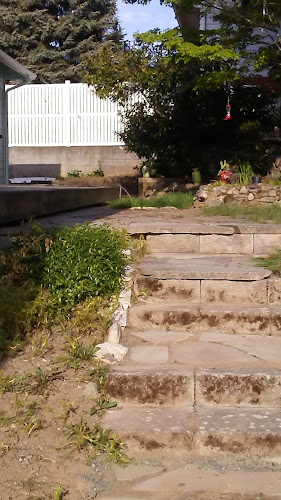
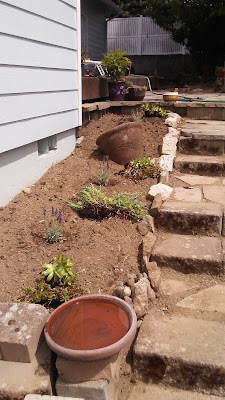
There is a set of stairs at the back of the house dividing the sloped south facing yard into two terraced levels. This is how the beds on both sides of the stairs looked in April when we moved in. The post today is only about the left side, which is up against the foundation of the house and south facing, so it is hot and dry.


My first thoughts were that lavender and sedums would be perfect plants for this area. Once established (after next year) they wouldn’t require a lot of watering as both thrive in hot dryish areas with all day sun, and they would provide food for bees, hummingbirds and other pollinators.


The only plants in that bed, aside from weeds, was a vinca tangled up with a Euonymus. The bed is just shy of 3 feet wide and 10 feet long.

Vinca is a vining, far reaching ground cover that is very ineffective at smothering out weeds and it will have to be constantly cut back if it isn’t to interfere with the walkway. It’s out.

The Euonymus is, to my taste, an uninteresting shrub that can reach out 4-6 feet wide and even taller. In this location it too would have to be pruned annually once it reached its mature size. And it would block the view of the garden I planned to create on the other side of the walk. Out it goes too.

The bed was bordered with rocks on the stair edge, presumably to stop the dirt from spilling out onto the stairs. As you can see over time the lower rocks became buried and weren’t doing the job. Lastly, there was a makeshift retaining wall made of mis-matched blocks at the bottom of the bed which had collapsed. Sorry, I didn't get a good photo of that.


All cleared away, now I have a blank slate to work with. First in goes 3 lavenders. “Goodwin Creek” to be specific. I have grown this one before and it is a favorite of mine. I love the indented leaf shape and it puts up long willowy wands of blooms which create lovely movement in the breeze. It also had a longer bloom time in my previous garden than other lavenders. It is a lovely variety. 

Along with the lavender, I added a broken portion of a Mexican pottery pot. I like using broken pots as a little interest, or whole pots turned on their side and angled just so. A little eye candy if you will.


After the lavenders are placed as the “bones” of the space, I filled in with sedums of many varieties from trailing types to hen’s and chicks types, all of which came with me from my previous garden. Sedums are incredibly easy to propagate. They will spread and fill in quickly.

As for the lost rocks edging the lowest steps, I pulled them up and re positioned them. I don’t really like rocks used that way but for now they will stay.


If all that isn’t exciting enough, now the icing on the cake happens! This is where my better half comes into his own. He is so creative and talented when it comes to hardscaping our garden spaces. He set about making a beautiful retaining wall to support the end of this bed. He used concrete blocks and capped them with flat stones. The blocks and stones had been left, stashed and buried in different places in this yard, by past owners.


First, he carved out the shape, and poured a footing in concrete.


Then cemented together blocks.


Then he ‘faced’ the blocks with a rough smear of mortar. 

He adds color powder to the mortar to give an aged look to his stucco finish. New concrete dries bright whitish and isn’t particularly lovely. The new brightness can be distracting in the garden, I think. Concrete does darken over time but it takes years. He ‘ages’ it by darkening it with coloring agents so the new wall looks like it’s been there for a long time and it blends better in the garden. I love the rough look of a stucco finish. It transports me to Tuscany or south of the border.


Then he capped it all off with some slate or what ever this stone is. There were several pieces of this stone laying around, apparently left-overs from the construction of the patio some years ago. I am so glad to have them as they are just perfect to finish this wall.


So… what do you think? Coming along nicely, I think. In a year or two you won’t see much, if any, soil after these plants fill in. Covered soil means less weeds. Win Win.

Cheers!

In Bloom in my Garden Today: Rose, Sedum, Agastache, Geum, Fuchsia, Salvia, Verbena, Gladiolus, Mullen, Thyme, Oregano, Calendula, Yarrow, Dianthus, Germander, Cuphea,

Author’s photos

Sunday, June 28, 2020

Let the Fun Begin


My favorite flower is a dandelion, because they are everywhere!
~ Garden art contest entry, age 9

We have moved. We found this garden, I mean house in March, and began moving in April. As gardeners, you know those months in late winter and early spring are crucial for getting ahead of the weed fight. And weeds did this garden space have.

So since April, as soon as it was prudent for me to get my hands in the dirt of the new grounds while the closing-of-a-house process hummed along, I have been doing weed patrol on our new-to-us 9000 sq ft corner lot. The front has a wraparound rockery that is taller than I am, sporting beautiful big boulders. The back yard is terraced with smaller rocks.

The quote above doesn’t reflect my feelings for dandelions, which were legion in number and already blooming in every part of this yard. Truly they were everywhere. When kept in check and not allowed to form seed heads, dandelion flowers provide healthy pollen and nectar for pollinators and leafy greens for people’s food source. But when allowed to spread in urban environments they are a nuisance weed.

As I was pulling dandelions, (and shrieking at those that had already turned to seed puffs) I was also discovering fireweed (Chamerion angustifolium), cleavers (Galium aparine), perennial pea (Lathyrus latifolius, which is on the Washington State Monitor list for noxious weeds), and a lot of turf grass that self-seeded in and amongst the perennials. Thankfully I have found no horsetail and only a few sprouts of English ivy.

The previous gardener put in some lovely perennial selections in the front rockery, which I will keep and perhaps divide or move to other parts of the garden. They also enjoyed self-seeding annuals like forget-me-not, Cosmos, Calendula and Nigella. 

I will keep the Calendula but reduce it to a lesser amount and collect the seeds to sow them where I want more, whereby controlling it’s spread.

I have grown Nigella before. It is also called "Love-in-a-Mist. It has a lovely flower  and the seed is used in some cultures for culinary purposes. You can control it's spread by cutting off the seed heads before they dry. If you want to save the seed for later sowing, allow them to dry on the plant naturally but remove them just as the little holes are opening on the top of the seed pod. 

Here (shown below) in the backyard terraces Nigella were allowed to self-sow and were rampant, thickly carpeting large areas with a mix of turf grass, dandelion, forget-me not and Nigella all tangling with Vinca Minor.


Out it all goes. While some gardens look lovely when annuals self-sow, they are a lot of work to keep contained and mostly look weedy to me, entangling themselves with surrounding plants. Not only that, Forget-me-not is one of those annuals that gets mildew as the plant dies down and looks ugly.

Back to the rockery in front (photo below). I will keep some of the Shasta Daisy and one or two of the Lemon Balm but cutting out quite a lot of both that have taken over and crowded out several other lovely hybrid varieties of Sage, Marjoram and Oregano. I have also pulled out Rumex which will self sow everywhere if given the chance. I will be adding in my favorites and many plant divisions I have taken from my previous garden. Yes, since the previous house is not yet listed for sale, I have been digging in my former garden but not so as to leave gaping holes. My old garden is so packed, I can easily remove favorite divisions without leaving a trace. 😊

Following posts will be the changes I make to edit this lovely garden and make it into my own. And yes, for those who know me and my methods, there will be lots of cardboard used. Good thing I have lots of packing boxes!


In bloom in my garden today: Dianthus, Veronica, Cuphea vermillionare, Hebe, rose, Shasta daisy, Calendula, Potentilla, Astrantia Major, Spirea

Author’s photos

Friday, January 29, 2016

Is Btk Safe for Honeybees?


Education is learning what you didn't even know you didn't know.
Daniel J. Boorstin
 According to the Peninsula Daily News, “State agriculture officials will decide soon whether to propose spraying a biological pesticide over 10,500 acres across seven sites in Western Washington to kill leaf-eating gypsy moths. Washington and Oregon States will be doing a spray program this year (2016). The proposed Washington sites are Kent, N.E. Tacoma, Port of Tacoma, Fife, Milton, Vancouver, Port of Vancouver, Nisqually, Lacey, Gig Harbor and Seattle’s Capitol Hill neighborhood. Washington would conduct three aerial sprayings, seven to 10 days apart, in April. In Oregon, state officials propose spraying in mid-April by helicopter over targeted areas of Forest Park, north Portland and Hayden Island with three treatments.“ 


There is much talk in my community about government aerial spraying for gypsy moth this year. And there’s a lot of fear about aerial spraying of any kind, especially in the beekeeping circles. We beekeepers have enough trouble with neighbors spraying insecticides, combatting known and unknown bee diseases, raising healthy bees with organic methods and winter die off. Now add the element of overhead spraying…aargh! ENOUGH CHEMICALS ALREADY!!
 But wait…we’re talking about Bt here. What is it really?
According to Rodale’s All New Encyclopedia of Organic Gardening (1992) “Microbial insecticides such as Bt and it’s varieties are effective, slow acting pesticides with virtually no harmful side effects and considered non-toxic to mammals.”
In Garden Insects (2004) Whitney Cranshaw writes “Bt is the best known bacterium…and is commonly  used as a microbial insecticide. Several strains exist, each of which affects only certain types of insects that ingest the bacteria or the toxic protein crystal it produces”. 
On the subject of organic beekeeping, Ross Conrad is my go to guy for my beekeeping questions. He is an author and organic beekeeper. For cases of preventing wax moths in bee hive equipment, in his book “Natural Beekeeping” (2007) he touched on the use of Bt for control of wax moth, a highly destructive insect in bee hives.  He writes “Bt has been used safely by the organic farming community for decades… is a bacterium that, when ingested by certain insect larvae, will kill the host…it becomes toxic only when exposed to the unique digestive environment found within the wax worm’s gut. There are no harmful side effects like with chemical (synthetic) pesticides.  Bt is sprayed directly onto the plant’s leaf. The toxin is not produced until the pests eats a leaf upon which the Bt microbe rests, it is safe and non-toxic to animals, humans, and beneficial insects, and it may be used right up until harvest. Also used by organic beekeepers as a safe alternative to moth balls for preventing wax moth infestations in empty hive equipment.” In this case Bt can be sprayed on frames and hive bodies that will be stored for later use. The presence of the bacterium will kill any larvae that hatches and feeds on the wax.
Gypsy moth, today’s subject, is a major pest known to defoliate millions of acres of hardwood forests annually and perpetually defoliated trees means death. WSDA claims gypsy moth control is often necessary to prevent damage in backyards and many urban areas to help stop the spread into neighboring forested areas. Bacillus thuringiensis subspecies kurstaki (Btk) is the variety of insecticide of choice for this insect. Btk is a natural soil born bacteria which biodegrades in sunlight within about 10 days, hence the multiple applications and it will likely be done at night, minimizing exposure to people and animals and for sure honey bees who don’t fly at night or eat leaves. What about the leaf cutter bees, our native pollinators...they wrap their nests with leaves but they do not eat the leaves so this poses no harm to them either. And I don’t see their activity in my garden that early in the spring.
 mindfully.org writes “However, in their natural form, acute toxicity of commonly-used Bt varieties is limited to caterpillars, mosquito larvae, and beetle larvae. Bt var. kurstaki which cause disease in moth and butterfly caterpillars.”
 Yes, Btk would mean death to butterfly larvae too. However the spray applications will be in April. I don’t know if our native butterflies breed in temps that cold here in the Pacific Northwest, and those that migrate from warmer climates to our south don’t arrive till June. I did some research on temperatures necessary for butterfly breeding but couldn’t find a definitive answer. If you know, please drop a line in the comments section. The cooperative extension in Wisconsin suggests “If you are concerned about your butterfly garden plants being sprayed (with Btk), place a tarp over them the night before a spray is scheduled. Then, remove it after spraying is completed.”
 Part of the controversy also lies in the fact that caterpillars, larvae and even moths are a food source for birds. While the infected larvae won’t be harmful to birds, the lack of their populations could represent a decline in a food source for birds.
 The gypsy moths found in Washington and Oregon are two non-native species (European and Asian) of insects that have the potential to devastate our forested lands. They have been brought here inadvertently by international trade. In cases like this we must pick the lesser of two evils and I think a timely and occasional spray with an organic control as deemed necessary when populations show sustained increase is prudent. Yes, you will find extreme cases of human illness due to overexposure if you dig deep enough online but I think by and large it’s a safe choice considering the other alternatives. The cases I found were due to overexposure by splashing large quantities of the liquid on themselves as opposed to a focused spray or drift. Naturally if you are highly sensitive, it is suggested that you stay indoors during the spraying.  Maps of proposed spray areas are published online in states that I found using this method, but do keep in mind drift can enlarge targeted areas.
 My personal opinion? I am not a chemist or a scientist. I’m an organic gardener and beekeeper. I use integrated pest management (IPM) practices. I’m sick to death of all the synthetic chemicals in the world and I use natural, organic methods that include biological controls when I have an infestation that the birds and other predators are not controlling. Bt is one biological control that I have used many times. I’ve been using Bt to combat cabbage moth for years. And I think I’m safe to say, most if not all organic farmers have been using Bt to control leaf eating worms and larvae for eons. The way it works is topically. The bacteria adheres to the outside of the leaf and when the larvae eats the leaf it ingests the bacteria. Bt does not penetrate the leaf so will not be effective on leaf miners. Nor is it effective on adult moths. The larvae must be young. It does break down and does not stay of the leaf, so in the case of my cabbage moths, who lay eggs all summer on all brassicas, I spray weekly, in the evenings all summer.
 The method of Btk is proven effective and the least toxic available, so is prudent and organically approved.  After all, the goal of organic farming is to use the least toxic method to control pests and disease. Btk is far less toxic than the synthetic chemical choices out there.
 In Bloom In My Garden Today: crocus, Erysimum ‘Rysi Moon’, Heath (Erica carnea ‘springwood white’), Sarcococca confusa, Hellebore, Galanthus elwesii (snowdrops), viola, pansies
 Author’s photo of my bees


Saturday, January 31, 2015

Winter Fragrance


Give me odorous at sunrise a garden of beautiful flowers where I can walk undisturbed.  ~Walt Whitman


It’s January, and winter is in full swing up here in the northern hemisphere. Which means every time I step out my back door I am greeted, nay assailed by the heady fragrance of my Sarcoccoa confusa bush. This evergreen delight is planted near my front door, but the scent wafts completely around the house on the air currents to perfume my back yard too. Follow this link to my previously published work for its particulars.

As I walk around my city’s neighborhoods I find it everywhere by following the fragrance as it ebbs and flows across my path. It is in full bloom now and will soon be followed by Daphne odora (Winter Daphne), then after that Skimmia japonica, all of which will keep you in a sweet-scented state of enchantment through March.

So here’s a heads up…if you live in the Pacific Northwest, get to your local nursery now. Sarcoccoa will be blooming and for sale, ready and waiting to be added to your garden.

Oh, and a BONUS! Hummingbirds sip of it's nectar daily and honey bees take full advantage of its pollen and nectar offerings when the temperatures are mild. I see both on mine.

In bloom in my garden today: Cyclamen coum (spring), Galanthus elwesii (snow drops), crocus, primrose, Sarcococca confusa, Heath (Erica carnea ‘springwood white’), hellebore

Author’s photo

Wednesday, February 26, 2014

A Season of Transition


Childhood scenes rushed back at me out of the night, strangely close and urgent. Today I know that such memories are the key not to the past, but to the future. I know that the experiences of our lives, when we let God use them, become the mysterious and perfect preparation for the work He will give us to do.
~Corrie Ten Boom, The Hiding Place p. 31

My dad was my beekeeping partner. Our beekeeping days are over. His body let go of his life on earth on Valentine’s Day.
 

Make no mistake, caregiving for a loved one is a heavy load to bear for both the giver and the receiver, and because of our group effort my sisters and I managed to keep dad in his own home to the end. I’ll not be the one to write the how-to book on making the journey a happy success, but I can say it’s a season of learning and growing in ways that will either make you or break you. It’s a time of running open-armed toward your beloved parent to help with all your heart and yet also a time (more often than I care to admit) when you look up at God with tears streaming down your face, stamping your foot, fists clenched by your side and yelling “No, no, no! It’s too hard God, I can’t do this anymore! Whatever made you think I could?” Then, just like after all moments like that I hear His quiet, soft voice “Be still and know that I am with you.” It’s a total immersion system of learning, overwhelming to say the least, yet a blessing to say the most.

I am coming to the conclusion that there is no higher calling than that of service to another. And that there may be no calling more difficult. I am coming off 10 years of answering such a calling. I have battle scars. I have amazingly joyful memories of laughter and shared jokes. I have sad memories of impatience and frustration bubbling up from deep within both dad and me.  I have stretch marks on my soul as I’ve been taken beyond my comfort zone time and again. I have grayer hair, longer laugh lines and deeper worry creases than I would have had I not stumbled down this path with both of my parents. I am blessed to have had the dad I had and the opportunities to be a blessing to him. I think that while my mental and physical commitment to be there for my dad in his old age is over, the lessons I will learn are still on the horizon waiting to dawn with new understanding when the time is right to reflect.

I was having some tearful moments as my sisters and I were arranging the funeral services for dad and I was feeling so very…oh I don’t know, just really missing his presence. We were in his house and I had my mini laptop with me. We were using it to write out his obituary. As we paused to discuss other things, it sat unused for a few minutes so the screen had gone black. When I picked it up again the screen came alive with a picture of dad on his riding lawnmower. A FULL screen photo. It was the same shot of him I used in his last Christmas letter to friends and family. In it he is riding away with his back toward me. I was so stunned. Then it flashed off after about 3 seconds. It wouldn’t came back up. I never downloaded that photo or any other photos to that computer, I just use it for written documents. I wrote the Christmas letter on my larger laptop where we have a photo program.

 
Later that night as I was transferring documents from my mini computer to a larger one so I could email the obituary information we’d written that day, after a period of idle the mini went to sleep. Then it happened again.  When I went to shut it down, a different photo of my dad flashed on the screen for a split second. It was a photo of him smiling directly at me, which I took at Christmas a year ago. Again the image filled the entire screen. No edges, no borders.

This business with photos flashing on the screen has NEVER happened before. I decided to do a little investigating on this computer, wanting and yet not wanting, to make some sense of it. It didn’t come with a photo program, and I never downloaded photos onto it but after looking I found some in a folder. I periodically send documents from this computer to a flash drive so I can put them on my larger computer and visa-versa. I can only surmise that it is during some of those transferring of docs via the flash-drive that maybe a dozen or so photos loaded inadvertently onto the mini computer, but then I’m not a tech-wiz.

There are other photos, not all of dad, in this rogue folder. A few of other family members, a dog, and clock parts from when we were working on his clock repair projects and we didn’t want to forget how to put the thing back together again. But only the photos of dad are flashing on the screen for a second or two, never any of the others. In my heart I know I need surmise no more. Whatever the technical explanation I know the true reason behind it. The photos appearing were simply gifts of God, given through the opportunity of that moment, my computer screen. The photos brought dad’s very real presence and comfort to me when I needed it the most on that difficult day. If you are a regular reader of my blog you may remember the post Garden of Memories, in which I also tell of holy gifts of comfort for me from God and mom surrounding her sudden death.

Days later we once again made the 3 hour drive across the mountains to the cemetery my parents chose as their place of burial. The last time I was there was to put roses on my mother’s grave. It was a tense drive over the mountain pass as a lot of snow had fallen just in the days before. Thankfully, as we wound our way down from the summit, the weather gave way to a sunny February day. Just as my parents wanted, we planned another simple, quiet, family, graveside service. I was surprised how calm and almost warm the weather was for us in those moments. It was February in Eastern Washington after all. The pastor spoke, then a few of us spoke as to dad’s life, memories, accomplishments and kindnesses to others and the service concluded. I stood by his casket, touching the smooth wood, pulling out a rose from the casket spray to take home with me then touching the other flowers. I wasn’t even conscious of people around me, it was just me and dad in that moment. As I was talking to him, one last good bye, just thinking and remembering, a stiff, cold, persistent wind rose up and blew from behind my back, pushing me. It was as if dad was saying, “Ok, it’s done, get on with your life. Go on, go home.” The wind didn’t let up and cleared those away quickly who had gathered to honor dad. He wasn’t really one to dither or linger unnecessarily. We did have to get on with a small family meal then get back over the mountain before darkness made it more difficult. The next day, two feet of snow fell up there and they closed the pass intermittently for avalanche control. God indeed did give us a window of sunshine and safety for such a sad day.

Today I look out at my February garden. It’s raining. Cold. A few crocus and snowdrops are blooming; hellebores too are lifting their blooms in defiance, not willing to be deterred by gray, wet days. One wee viola peeks up from within its leafy blanket and the tender bright green leaves of Clematis unfold, vulnerable yet undeterred. Heath offers its nectar to bees who won’t find it because it’s too cold for them to fly. Winter ebbs and flows in these weeks of transition toward spring, yielding to a mild day here then a cold day there, yet not willing to let go. Garden renewal has begun its process forward and won’t be stopped, but merely slowed if an Arctic Blast follows on the heels of a few balmy days. I contemplate what’s next for me. I’ll look for employment, one of the many things I let go of in my own life to be better able to help him in his. Will I do bees again this year? I’m kinda weary. Maybe I’ll wait till next year with bees, if ever. I wonder if dad’s colony is still alive and if so will I bring them here to my garden or give them to one of his beekeeping friends? I wonder if beekeeping will ever be the same for me as it was when we had it together. This too is a time of ebbing and flowing for me as I regroup and plan my next steps. I feel dad urging me to get on with my life, don’t linger or dither, move forward.

It occurs to me my grieving process is much like spring in the garden. A time of transition, in which there is much ebbing and flowing. Cold and dark giving way to warmth and light then back again. Progress toward joy on the horizon, yet returning to tears and melancholy when I least expect it. A confusion of emotions, what if’s and needs giving way at times to bright moments of clarity and strongly rooted determination. Renewal. And all the while God is there, holding me up, giving encouragement, letting me find my way without ever leaving my side. Growing me past my comfort zone, giving me the strength to pick myself up, dust myself off and start all over again with His ever-present whisper “Be Still”.

And I smile. As I resume to edit this post, the sleeping mini computer awakens and there again dad on his mower flashed for less than a brief second across the screen.
This time not a full screen shot but smaller, and a briefer span of time. It’s almost as if he’s fading from me. I’m not really ready for that yet. It’s only been a week. Perhaps I really am healing and letting go.
  
I love you Dad.


In Bloom In My Garden Today: Crocus, Viola, Hellebore, Heath (Erica carnea ‘springwood white’), Cyclamen coum

Authors photo

Wednesday, September 18, 2013

Apiary Update


For bees, the flower is the fountain of life. For flowers, the bee is the messenger of love.
~Kahlil Gibran
 
I am sad to report that my bees have all died this year. We did our utmost to keep the hive alive this spring. I could see that it was failing and that the queen had disappeared so we inserted a few frames with new eggs and some brood from a strong hive so they could make their own queen, which they did, but within a few months it had completely died. Not sure why but such is the way of beekeeping in these difficult and troubling times for the bees.

Happily there are several beekeepers within blocks of my urban home and their bees are going to town these sunny days on my Silver Vein Creeper (Parthenocissus henryana), packing full the pollen sacks on their legs.


I planted this vine years ago to camouflage an otherwise boring fence and I’ve been so happy with it. It grows to 10 feet long (3 meters) so it nicely covers a 6 foot (1.8m) fence, draping gracefully over the other side as seen above.

 
The leaves are a silver-veined green turning a lovely apricot in the fall. A perfect backdrop to the fall blooming and fragrant Gladiolus callianthus (formerly Acidanthera). While in the photo above the background of these leaves is in fuzzy focus, you can get an idea of the colors.

 
The vine's flowers are considered ‘insignificant’ in the gardening world, which just means they are so small they are hardly visible, but for the bees they pack a wallop in the pollen department. In the above photo is an opened flower, pollen exposed. Below you can see the vines are covered with flower buds, just a tad bigger than a pinhead.

 
This is neither a messy vine nor a thug by any means. It is deciduous, so the leaves drop off for the winter, making great mulch and providing easy access to the vines to prune and control as you please in late winter, early spring. This is when I thin it out and corral its growth. It can take sun to part shade and is hardy to USDA zone 4. It is self attaching, meaning it puts out little tendrils which find a flat surface then stick to it with little round pads, like frogs ‘toes’, if you will. These tendrils will also curl around a wire support if you choose to use a trellis.

Overall a very easy and versatile vine. I highly recommend it, especially for the bees!

In Bloom In My Garden Today: Alyssum, Begonia ‘bonfire’, Caryopteris ‘longwood blue’ (bluebeard), Cimicifuga simplex ‘brunette’, Coreopsis ‘moonbeam’, Cyclamen, Daisy(white double), Daphne caucasica ‘Eternal Fragrance’, Echinacea pallida, Echinacea purpurea magnus, Fuchsia, Gaillardia (blanket flower), Gladiolus callianthus (formerly Acidanthera), Kirengeshoma palmata, Kniphofia ‘echo mango’Mullen chaixii ‘Album’, Nepeta ‘six hills giant’ (catmint), Perovskia ‘little spire’, Phygelius ‘new sensation’ (cape fushia), Rose, Salvia, Star Jasmine (trachelospermum jasminoides), Tomato

Authors photos

Thursday, February 14, 2013

Worth The Effort


"An addiction to gardening is not all bad when you consider all the other choices in life."
 ~Cora Lea Bell

It’s a gray, cool day today with a mist ever so slight that it moistens the face but is gone before it hits the ground. The birds are loving it as they are in full force today singing and foraging in the garden. It’s warm enough for the bees to fly too. That’s great news to a Pacific Northwestern beekeeper in February.

I came across this whilst I was out and about today.


Don’t you just love it when you see people taking responsibility for their actions and care for those around them who share the world with them?

I do.

Here are the links
www.beyondpesticides.org
http://www.nwf.org/CertifiedWildlifeHabitat/

In Bloom in My Garden Today: Cyclamen coum, Galanthus elwesii (snowdrops), Heath (Erica carnea ‘springwood white’), Hellebore, Rhododendron, Sarcococca confusa,
 
Authors photo