Showing posts with label herbs. Show all posts

Saturday, September 12, 2020

In the Hot Bed


Gardening requires lots of water – most of it in the form of perspiration. 

~Lou Erickson

There is a set of stairs at the back of the house dividing the sloped south facing yard into two terraced levels. This is how the beds on both sides of the stairs looked in April when we moved in. The post today is only about the left side, which is up against the foundation of the house and south facing, so it is hot and dry.


My first thoughts were that lavender and sedums would be perfect plants for this area. Once established (after next year) they wouldn’t require a lot of watering as both thrive in hot dryish areas with all day sun, and they would provide food for bees, hummingbirds and other pollinators.
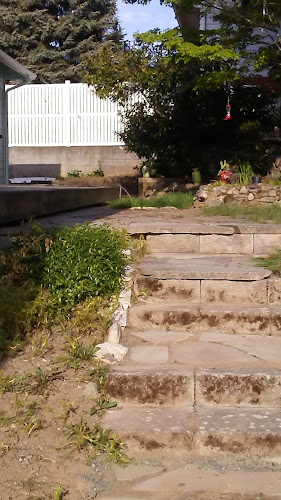
 

The only plants in that bed, aside from weeds, was a vinca tangled up with a Euonymus. The bed is just shy of 3 feet wide and 10 feet long.

Vinca is a vining, far reaching ground cover that is very ineffective at smothering out weeds and it will have to be constantly cut back if it isn’t to interfere with the walkway. It’s out.

The Euonymus is, to my taste, an uninteresting shrub that can reach out 4-6 feet wide and even taller. In this location it too would have to be pruned annually once it reached its mature size. And it would block the view of the garden I planned to create on the other side of the walk. Out it goes too.

The bed was bordered with rocks on the stair edge, presumably to stop the dirt from spilling out onto the stairs. As you can see over time the lower rocks became buried and weren’t doing the job. Lastly, there was a makeshift retaining wall made of mis-matched blocks at the bottom of the bed which had collapsed. Sorry, I didn't get a good photo of that.


All cleared away, now I have a blank slate to work with. First in goes 3 lavenders. “Goodwin Creek” to be specific. I have grown this one before and it is a favorite of mine. I love the indented leaf shape and it puts up long willowy wands of blooms which create lovely movement in the breeze. It also had a longer bloom time in my previous garden than other lavenders. It is a lovely variety. 

Along with the lavender, I added a broken portion of a Mexican pottery pot. I like using broken pots as a little interest, or whole pots turned on their side and angled just so. A little eye candy if you will.


After the lavenders are placed as the “bones” of the space, I filled in with sedums of many varieties from trailing types to hen’s and chicks types, all of which came with me from my previous garden. Sedums are incredibly easy to propagate. They will spread and fill in quickly.

As for the lost rocks edging the lowest steps, I pulled them up and re positioned them. I don’t really like rocks used that way but for now they will stay.
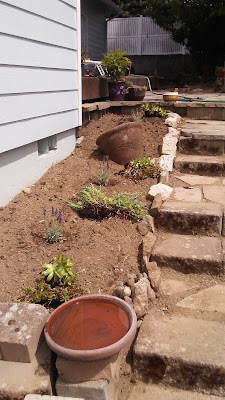
 

If all that isn’t exciting enough, now the icing on the cake happens! This is where my better half comes into his own. He is so creative and talented when it comes to hardscaping our garden spaces. He set about making a beautiful retaining wall to support the end of this bed. He used concrete blocks and capped them with flat stones. The blocks and stones had been left, stashed and buried in different places in this yard, by past owners.


First, he carved out the shape, and poured a footing in concrete.


Then cemented together blocks.


Then he ‘faced’ the blocks with a rough smear of mortar. 

He adds color powder to the mortar to give an aged look to his stucco finish. New concrete dries bright whitish and isn’t particularly lovely. The new brightness can be distracting in the garden, I think. Concrete does darken over time but it takes years. He ‘ages’ it by darkening it with coloring agents so the new wall looks like it’s been there for a long time and it blends better in the garden. I love the rough look of a stucco finish. It transports me to Tuscany or south of the border.


Then he capped it all off with some slate or what ever this stone is. There were several pieces of this stone laying around, apparently left-overs from the construction of the patio some years ago. I am so glad to have them as they are just perfect to finish this wall.


So… what do you think? Coming along nicely, I think. In a year or two you won’t see much, if any, soil after these plants fill in. Covered soil means less weeds. Win Win.

Cheers!

In Bloom in my Garden Today: Rose, Sedum, Agastache, Geum, Fuchsia, Salvia, Verbena, Gladiolus, Mullen, Thyme, Oregano, Calendula, Yarrow, Dianthus, Germander, Cuphea,

Author’s photos

Friday, August 3, 2012

Echinacea (Cone Flower)

Where flowers bloom, so does hope. 
~Lady Bird Johnson, First Lady and wildflower advocate, 1912-2007

This beautiful flower with droopy petals and an ever elongating seed head is also a medicinal plant used throughout history, its properties easing illness and boosting our immunity.  But don’t go eating any of these plants in your garden, not all of them are used for medicinal purposes. 

 For years I had an Echinacea plant, barely alive in a sunny spot on the sunny south side of my house.  I couldn’t figure out what was keeping it from thriving.  I moved it to a slightly less hot, sunny spot but still it just sat there and looked worse and worse.  Finally I decided to get serious so I moved it again to a different sunny spot.  I also planted about 5 more along side, creating a large patch of Echinacea.  Since then I have added more and they are all growing and thriving.  I think the first two spots were too wet of soil, one being by a downspout and the other had shrubs shading the soil too much.  Sometimes it takes a few moves to find just the right place, so don’t get frustrated if a plant seems to fail…try moving it.  This is one plant where one just isn’t enough.  A single plant seems puny but en-masse it is a sight to behold.  Begin with no less than 3 plants, planted in a triangle, 20 inches (51 cm) apart if you want to make an impact in your garden.

There are many species of Echinacea, all native to North America.  You might be most familiar with the purple varieties but in the past several years Echinacea has become a favorite among hybridizers, introducing new colors of yellows and oranges every year.  I still prefer the standard purple though I’ve seen a soft butter yellow that I’d love to bring into my garden someday.

Most common in gardens and nurseries in my region is Echinacea purpurea or Eastern purple Coneflower.  It is a robust, stocky flower and plant with deeper green leaves as seen here in my garden.


Pictured next is Echinacea pallida, a more delicate species.  It is just beautiful.  It has a much softer color and the petal is longer…flowing, a little like ribbons around the May pole.


Overall the plant structure of E. pallida is more delicate and open than the E. purpurea species as you can see the two side by side below (E. pallida is on the left).   The only negative thing I can say about E. pallida is that its stems are not as strong as E. purpurea so I’ve had to stake the plant.  I’ve not had to stake E. purpurea, though after a windstorm a stem or two does need help.  With E. pallida the overall plant leans over so one encircling or half circle support is all that is needed.   Perhaps if you plant your E. pallida amonst your E. purpureas they will provide all the support needed for the other.  I need to move one and will be trying that this year.  Normally I don’t like staking plants…who’s got time for all that fussing.  But there are some plants that are so beloved either for their look, color or fragrance that in order to keep them one must make the choice to stake.  Like many things in life you must pick your battles.  Echinacea pallida is worth it for me.


Plant your Echinacea in a full sun location.  Keep them well watered until they get established, at least for the first year, perhaps into the second.  Even with our rainy weather, keep an eye on the level of soil moisture.  That first year of establishing in a garden the plant must develop a strong root network.  Don’t keep them too wet though, as roots need the soil to dry a little so oxygen can reach into the soil pockets too.  Only after they are established will they handle the stress of drought.

The pollen and nectar are gathered by bees and butterflies in the summer.  I do not suggest you deadhead your Echinacea.  If you do you will miss the fun of seeing the song birds in the winter feasting on the seeds.  It is a plant that truly provides food for your garden wildlife practically year round.

The most commonly sold Echinacea in western U.S. nurseries is E. purpurea.  Finding E. pallida may take more work but if you like variety and rarities in your garden it is well worth the effort.

In Bloom in my Garden Today: Agastache foeniculum (anise hyssop), Alpine Strawberries, Alyssum, Astilbe, ‘Begonia ‘bonfire’, Bletilla pink, Borage, Coreopsis ‘moonbeam’, Daphne caucasica, Digitalis grandiflora, Echinacea, Fuchsia, Gaillardia (blanket flower), Geum, Geranium ‘mavis simpson’, Green Beans, Heuchera, Hosta, Kniphofia ‘echo mango, ’Lavender, Lilium tigrinum ‘splendens’, Lily, Lobelia, Mullen chaixii ‘Album’, Nepeta ‘six hills giant’ (catmint), Perovskia ‘little spire’, Phygelius ‘new sensation’ (cape fushia), Purple poppies, Rose, Salvia, Scheherazade oriental lily, Schizostylis ‘watermelon’, Sedum, Star Jasmine (trachelospermum jasminoides), Thyme ‘foxley’, Tigridia (Mexican Shell Flower), Tomato, Zucchini, Veronica,

Authors photos

Wednesday, June 30, 2010

Shriveled Sage, Crispy Rosemary and Black Basil

The garden is the poor man's apothecary.
~German Proverb

Does your herb garden produce more fresh savories than you can possibly use in summer? Then drying and storing the leaves is the way to go so you can add their pungent essences to your culinary masterpieces all year long!

My three favorite herbs to grow and cook with are Basil, Rosemary and Sage. Basil thrives in hot conditions though is shallow rooted so doesn’t like the soil to dry out. One source speculates that Basil may have originated in India, but is better known in Mediterranean and Middle Eastern cuisine (Herbs and Spices by Mary Trewby). Basil leaves taste best fresh but another source suggests when preserving, put the leaves into a jar, sprinkle a little salt between layers, and fill the jar with olive oil (Herbs by Susan Fleming). The leaves will blacken but they and the oil will flavor your dishes nicely.

I’ve tried growing the big ‘lettuce leaf’ Basil (Ocimum basicicum), unsuccessfully. Perhaps my garden just doesn’t get hot enough for it to thrive, so I buy fresh organic whole Basil leaves on stems from the grocery store. But they last only a few days on the kitchen counter (refrigeration turns the leaves black) so I have to have several recipes in mind ready to use it every day. If I keep it too long, it wilts and turns brown. I thought I’d get smart and try to keep it longer. I cut about a ¼ inch (0.5 cm) off the base of the stems and put them in a glass of water, like flowers in a vase, and ya know…it worked. The leaves perked up and lasted about a week and a half so I didn’t feel like I had to use some every night for dinner.

When I lifted the last few stems I noticed they’d begun to root out! Well, being the thrifty gardener that I am I potted them up and I think they are growing. Ok, with the cold, wet spring we are having here they are not really GROWING, more like sulking. But potentially when summer gets here I could get 4 basil plants out of this! We’ll see. If you want to see true Basil growing success, check out Shari’s Bully Basil!  Shari’s experience prompted me to try again but with a different variety this time. So this year I bought some Greek Basil seed (Ocimum Balilicum minimum), a small leaf variety, growing to about 12 inches (25 cm). The seed germinated just fine and I have 6 seedlings, now with just a bit of continual summer heat they’ll be on their way. Still waiting for the heat.

I have better success growing sage and rosemary, which are perennials here. Both like the hot, dry Mediterranean sun with soils that drain well and are used extensively in that region’s cooking. Each spring when I prune my rosemary (Rosmarinus officinalis ‘Hill Hardy’) I bring leafy stems in to dry for later use. In April I pruned back my sage (Salvia officinalis) and brought in the stems with leaves attached to dry as well. I gave up hanging stems upside down…I don’t have the space for that, so I dry my herbs in the refrigerator.

With today’s refrigerators, long gone are the days we need to defrost our freezers. Refrigerators are now designed to do that automatically, and because of this they will dry out foods left uncovered on the refrigerator shelving. After rinsing and spin drying the stems with leaves, I lay them out on a flat tray and put them at the back of the fridge shelf till they are crispy dry. It could take several weeks this way. For faster results you could pull all the leaves off the stems, but that’s more work. It’s much easier to remove the crispy leaves after they’ve dried. Keep it to a single layer for faster drying. Turning them daily helps too, but I usually forget this step and they dry anyway. Then I crumble the leaves from the stems (discarding stems) and put them in glass jars in my spice cupboard. Since I don’t like the feel of whole spiky rosemary leaves in my mouth, I crush them a little and keep them in a spice grinder, grinding fresh the leaves for each use.

Honey bees like herbal nectars and studies have shown the compounds they contain may be beneficial in strengthening their immunity, so I’m increasing the variety of herbs I grow. Last year I planted 2 dwarf oregano (origanum vulgare compactum ‘humile’) plants. I have several creeping thymes among my paths but added 2 taller varieties this year, Lemon-Gold Variegated Thyme (Thymus citriodorus ‘Aurens’) who’s lemony scent should smell amazing on the grill this summer, and Thyme ‘Foxley’ (Thymus pulegioides ‘Foxley’) a gorgeous large leafed, variegated thyme. Also, I’ve added 2 upright Sicilian Oregano (Origanum sp.). Herb harvesting for culinary purposes is usually done just before flowering for best flavor. As you harvest stems and plant tips you will be delaying flowering. Keep in mind the bees get the nectar from the flowers, so if you want to serve the bees you may be harvesting less. Perhaps buy double the herb plants, leaving the flowers for the bees on some and harvesting the leaves for you from others.

I’ve found a wonderful Scarborough Fair Bread recipe linked here from Taste For Life magazine. If you were around in the 60’s you may remember the song, it includes “parsley, sage, rosemary and thyme”. I like the finished loaf but found it a bit weak on herbs. Being a recipe tweaker I substitute ¼ of the all purpose flour with whole wheat flour and I more than double the dried herbs. Not being a fan of parsley, I leave it out completely. The herby-yeasty aroma of this bread during the rising and baking is outstanding!

Now if I could only get that song out of my head!

In Bloom In My Garden Today: Bletilla (hardy orchid), Thalictrum rochebrunianum (Meadow Rue), Lavender ‘Hidcote’, Digitalis, Begonia ‘Bonfire’, Penstemon schmidel ‘Red Riding Hood’, Salvia officinalis (culinary sage), Salvia nemorosa ‘Viola Klose’, Astilbe ‘Bridal Veil’, Baptisia, Tomato ‘Stupice’, Dianthus (Pinks), Hardy Geranium, Peas, Heuchera ‘Palace Purple’, Armeria latifolia ‘Joystick’, Dianthus, Day Lily, Rose, Nepeta ‘Six Hills Giant’, Saxifrage, old fashioned Coral Bells (Heuchera), Alpine strawberry, Daphne caucasica ‘Eternal Fragrance’ and ‘Summer Ice’

Author’s photos