To see a World in a Grain of Sand
And a Heaven in a Wild Flower,
Hold Infinity in the palm of your hand
And Eternity in an hour.
~William Blake (Fragment from "Auguries of Innocence")
Nestled in the north end of the city of Tacoma, Washington USA is the W.W. Seymour Botanical Conservatory.
The community is fortunate beyond measure to have such a treasure in its midst. Listed in the city, state and National Historic Registers, the conservatory was built in 1907 and is one of only 3 on the US West Coast, the others being in Seattle and San Francisco.
On any given day, no matter what the weather outside you can walk into this tropical paradise, bask in its warmth and breathe in the beauty. It is kept at a balmy warm temperature and moderate humidity that makes all the plants thrive. The soft background music slows you down so it is easy to spend an hour taking in all the floral displays, which are changed with the seasons or to reflect holiday cheer. With the first step through the door, life’s stress seems to drop off your shoulders. You are transported to an Eden on this earth.
It is home to dozens of orchids…some rare and some fragrant. You’ll find varieties of palm trees, bird of paradise, papyrus, a lemon tree with huge fruits, a koi pond, flowering treasures from around the world, a gift shop and more.
Do you love orchids?…they have more than 200.
Do you love tropicals?…they have more than 250 plant species.
Do you love live music?…you can hear it there the 2nd Sunday of each month.
Do you love statuary?…they have several that reflect ancient African, Maori and Aztec cultures.
Even if you don’t love to garden but need a little (or a lot) of R&R from time to time, conservatories like this deliver! Wow do they deliver!
Do you have a conservatory nearby in your community? Do tell, I may want to come visit some day.
In Bloom In My Garden Today: English Daisy, Sarcococca, violet primrose
Photos courtesy of Pat Chissus
Wednesday, January 26, 2011
Tuesday, January 18, 2011
Soldier On
"I have seen women looking at jewelry ads with a misty eye and one hand resting on the heart, and I only know what they're feeling because that's how I read the seed catalogs in January."
~Barbara Kingsolver, Animal, Vegetable, Miracle 2007
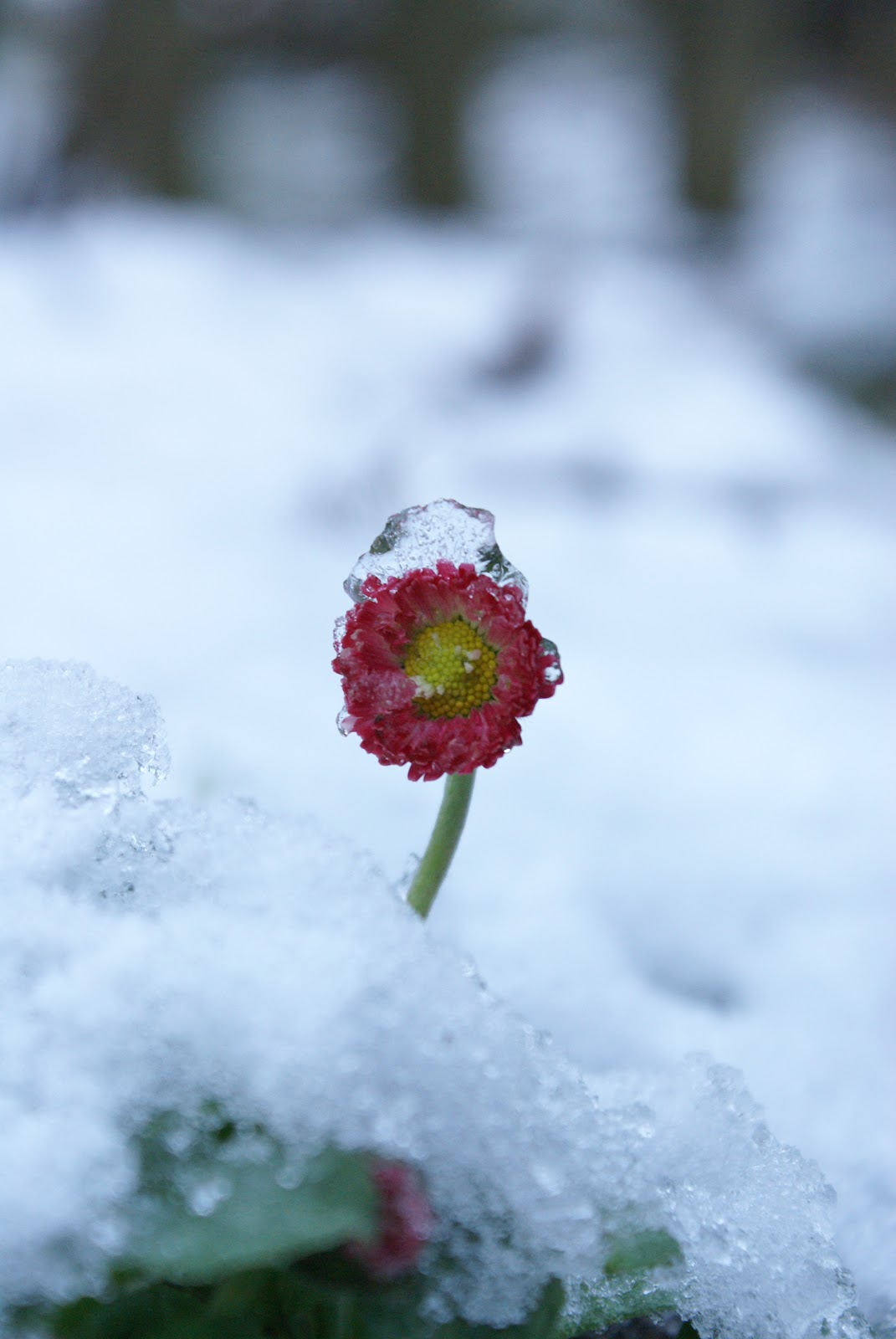
Well my friends I really must apologize to you. In the previous post about the snow that fell last week, I ended it with my usual listing of what’s blooming. I stated ‘no blooms’, but I obviously missed this little one. Check it out…such a trooper!
Have you ever been to Victoria B.C., to their parliament buildings? The expansive lawns are covered with these guys. So charming. Two springs ago, I ordered a packet of seed from Nichols Garden Nursery. I sprinkled some of the seed on my mossy path that leads to my compost bin. I just love diminutive plants amongst the pathway, so long as they don’t trip you and they can handle the occasional foot trod. The seed came up so prolifically I had to thin them out. What fun it is to see their cheerful faces. They bloom nearly non stop, even though the catalog says they are spring blooming. Here it is January and several of them are trying to bloom. Not a huge showing but a few flowers none the less, so on my list they go.
I’ll definitely be sowing some of these treasures in my lawn soon!
In Bloom In My Garden Today: bellis perennis, sarcococcoa, viola
Author’s photo
~Barbara Kingsolver, Animal, Vegetable, Miracle 2007
Well my friends I really must apologize to you. In the previous post about the snow that fell last week, I ended it with my usual listing of what’s blooming. I stated ‘no blooms’, but I obviously missed this little one. Check it out…such a trooper!
This is English Daisy (Bellis perennis), native to Europe and the Mediterranean region. This particular one is a horticultural variety I believe. The original species are single flowers, mostly white with a bit of pinkish tinge. It is a meadow plant that needs good soil, moisture, light shade in hot areas and full sun in cooler areas. It is super easy to sow from seed.
Have you ever been to Victoria B.C., to their parliament buildings? The expansive lawns are covered with these guys. So charming. Two springs ago, I ordered a packet of seed from Nichols Garden Nursery. I sprinkled some of the seed on my mossy path that leads to my compost bin. I just love diminutive plants amongst the pathway, so long as they don’t trip you and they can handle the occasional foot trod. The seed came up so prolifically I had to thin them out. What fun it is to see their cheerful faces. They bloom nearly non stop, even though the catalog says they are spring blooming. Here it is January and several of them are trying to bloom. Not a huge showing but a few flowers none the less, so on my list they go.
I’ll definitely be sowing some of these treasures in my lawn soon!
In Bloom In My Garden Today: bellis perennis, sarcococcoa, viola
Author’s photo
Wednesday, January 12, 2011
Just A Dusting
There's one good thing about snow, it makes your lawn look as nice as your neighbor's.
~ Clyde Moore
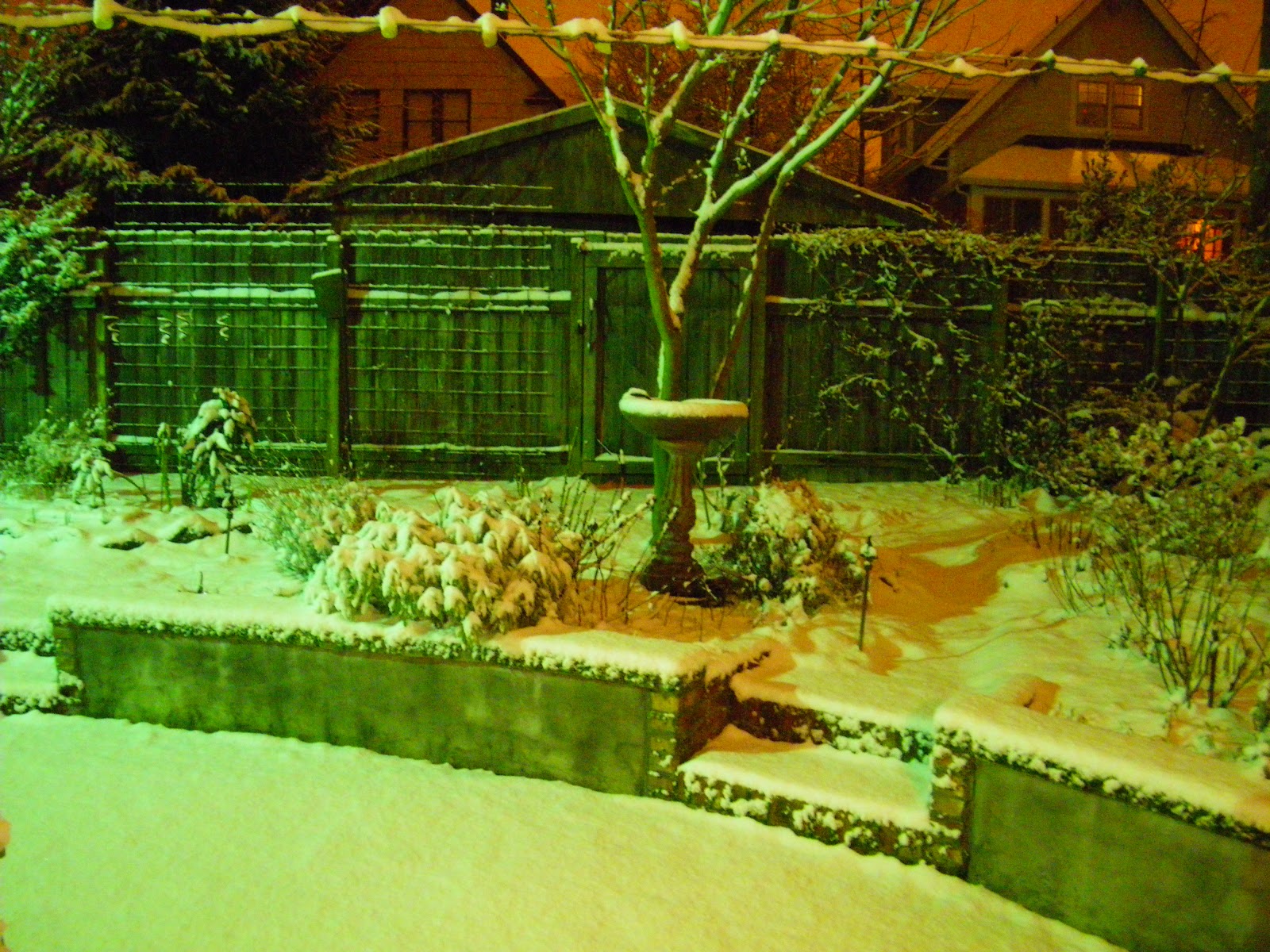
Just a quick post to show you the garden blanketed with last night’s snowfall. This is the perfect kind of snow (in my opinion) here in the lowlands. Here today, gone tomorrow. We got 3-4 inches (7-10cm) in just a few short hours to play in and enjoy but it’ll be all gone by mid-day today. No prolonged freeze to turn it all to ice for days on end, no commuting nightmare, just the fleeting beauty of it. Today’s rain will make short work of it and life will be back to normal. I had to get out before sunrise to snap the pictures before it melted away, it was warming up quickly. The green haze is the glow from our yard light, it doesn’t look that way to us but the camera picked it up.
What’s the weather like in your part of the world?
In Bloom in My Garden Today: no blooms but bulbs are pushing their way up and the Helleborus corsicus and Sarcococca confusa both have buds ready to open.
Authors photos
Tuesday, December 28, 2010
The Potted Garden
"When in these fresh mornings I go into my garden before anyone is awake, I go for the time being into perfect happiness. In this hour divinely fresh and still, the fair face of every flower salutes me with a silent joy. . . . All the cares, perplexities, and griefs of existence, all the burdens of life slip from my shoulders and leave me with the heart of a little child that asks nothing beyond the present moment of innocent bliss."
~ Celia Thaxter, 1835-1894, New England poet and author of An Island Garden
However there are some things to keep in mind if your garden is in pots.
• Water – pots can dry out faster than the ground, so you may be watering more often. You’ll need to dig down into the root area to see if the pot needs watering. Just looking at or touching the soil surface, which dries fastest, is not indicative of what the moisture level is at the roots. There are moisture meter probes available. I haven’t had the greatest success with them but they may be just the thing for you. I just worm my finger down into the soil an inch or two to test for moisture. Hanging pots or moss lined wire pots may need to be watered daily, especially if they are in windy or warm sunny places.
• Good drainage is life or death to potted plants. Roots need oxygen. Oxygen increases as soil dries out and creates air pockets. In the case of most plants if the soil never dries out, even just a little bit, the roots will drown and rot. I do not recommend keeping saucers under pots outside. The saucer will hold water which will wick back up keeping the soil too wet. Remove all saucers and if necessary add ‘pot feet’ under your pots. Pot feet lift the pot up off the ground so water will flow freely out. Depending on the surface your pots are on you may or may not need them. They come in many styles, shapes and sizes. You can buy specialty feet or just use a few bricks or flat stones. Rolling trays allow you to move your pots but if they are solid like a saucer, drill holes in them so you won’t have any sitting water. I find covering the hole with a small square of window screen material before you add the soil works better than stones or pottery chards which can shift and plug up the hole.
• Potting soil – Since I am an organic gardener I buy only potting soils and compost from organic sources. Organic soil companies are tested regularly so you can be sure you are not putting your plants into soil with petrochemicals that will leach out into your surrounding environs or taint your pot of veggies. I do not recommend any bagged soil or compost that has fertilizers added. You don’t know what they are using and the term ‘organic’ is being tossed around too freely and deceptively in the bagged soil industry. Buy your own organic fertilizers from reputable sources and add it yourself depending on the specific needs of the plant(s) in you pot. Potting soil has a neutral ph so if you have a pot for acid loving plants like blueberries, you’ll want to add some spent coffee grounds to raise the acidity level of the soil, and you’ll fertilize with an acid loving plant fertilizer.
• Fertilizer - There is no such thing as one fertilizer fits all. Depending on what you are growing, you’ll want an organic fertilizer that will boost flower and fruiting production, another to boost nitrogen for leaf production. Pots may need fertilizer added more frequently than garden beds because the available nutrients get pulled into the roots or flushed away with watering. Organic fertilizers break down more slowly than chemical fertilizers so you’ll be using a safer ingredient and fertilizing less often. Once in early spring and once in summer are enough for dry organic fertilizers, but synthetics may need to be added monthly or in 6 week intervals.
• The pots themselves – I prefer terracotta or glazed pots. I just like the look of them, but they are really heavy when filled, so they stay where they are. Terracotta can chip and crack. Every winter my terracotta pots show a bit more freeze damage. Some glazed terracotta is marketed as frost proof and will last longer with little or no damage depending on how fierce your winters are. If you need to move your pots, plastic may be perfect for you. Plastic is lighter and easier to move but deteriorates from the sun and becomes brittle over time. If your potted garden has perennials that you want to survive cold winters you’ll need to move them to protected areas. Pots do not provide the insulation from freezing to the root zone like ground soils.
• Moving pots - even if you don’t plan to move your pots, there are times it seems it must be done. If you are not Ms/Mr. Brawny, don’t happen to have a Mr. Brawny nearby, or are too impatient to wait for him to get his act together, treat yourself to a handy hand truck. Mine is small but has a 300 pound capacity. Try to find one with bowed support rungs in the back so your pot doesn’t go sliding off as you round a corner. You may want to strap your pot to it for better security. I wouldn’t get one with inflatable tires either, they always seem to be flat when you need it most. Solid, hard rubber tires or the like are fine, and the bigger the better if you have to go over bumpy ground.
For the sake of keeping this post from being pages and pages long I’ve not elaborated too much on several points. If I’ve left you with unanswered questions, please drop me a line in comments so we can chat more. Or take your questions to your local nursery where they will have pot feet and fertilizers and what you need to have an awesome potted garden.
May your garden be one of many sanctuaries of rest for you as mine is for me.
In Bloom In My Garden Today: sadly nothing to report
Author’s photo
~ Celia Thaxter, 1835-1894, New England poet and author of An Island Garden
The quote from Celia Thaxter above is one reason why I love gardening so. Years ago, at a particularly difficult time in my life, I stepped out my back door to begin yet another emotionally dark day. My burdens were too heavy. As I turned from the door toward the garage I heard my bubbling fountain, which caused me to look up. I hadn’t been looking up enough. I saw the sun was shining and my garden was there…in all it’s restful beauty. For a brief moment I stood there, looking and listening to the sounds of my garden and some of the burden slipped off my shoulders. I so needed that in that moment.
Everyone can experience that peace from a garden, whether it’s their own garden or a municipal garden or a park to visit. You don’t have to have acres of land or a big yard to have a garden. Many a garden is made up of pots. Big pots, small pots, lots of pots or just a few pots. The potted garden is just the thing if you are limited on time (far less weeding), space (think of balcony gardens), physical ability to reach the ground (easier digging and accessible by wheelchair) and easier to install than raised beds.
However there are some things to keep in mind if your garden is in pots.
• Water – pots can dry out faster than the ground, so you may be watering more often. You’ll need to dig down into the root area to see if the pot needs watering. Just looking at or touching the soil surface, which dries fastest, is not indicative of what the moisture level is at the roots. There are moisture meter probes available. I haven’t had the greatest success with them but they may be just the thing for you. I just worm my finger down into the soil an inch or two to test for moisture. Hanging pots or moss lined wire pots may need to be watered daily, especially if they are in windy or warm sunny places.
• Good drainage is life or death to potted plants. Roots need oxygen. Oxygen increases as soil dries out and creates air pockets. In the case of most plants if the soil never dries out, even just a little bit, the roots will drown and rot. I do not recommend keeping saucers under pots outside. The saucer will hold water which will wick back up keeping the soil too wet. Remove all saucers and if necessary add ‘pot feet’ under your pots. Pot feet lift the pot up off the ground so water will flow freely out. Depending on the surface your pots are on you may or may not need them. They come in many styles, shapes and sizes. You can buy specialty feet or just use a few bricks or flat stones. Rolling trays allow you to move your pots but if they are solid like a saucer, drill holes in them so you won’t have any sitting water. I find covering the hole with a small square of window screen material before you add the soil works better than stones or pottery chards which can shift and plug up the hole.
• Potting soil – Since I am an organic gardener I buy only potting soils and compost from organic sources. Organic soil companies are tested regularly so you can be sure you are not putting your plants into soil with petrochemicals that will leach out into your surrounding environs or taint your pot of veggies. I do not recommend any bagged soil or compost that has fertilizers added. You don’t know what they are using and the term ‘organic’ is being tossed around too freely and deceptively in the bagged soil industry. Buy your own organic fertilizers from reputable sources and add it yourself depending on the specific needs of the plant(s) in you pot. Potting soil has a neutral ph so if you have a pot for acid loving plants like blueberries, you’ll want to add some spent coffee grounds to raise the acidity level of the soil, and you’ll fertilize with an acid loving plant fertilizer.
• Fertilizer - There is no such thing as one fertilizer fits all. Depending on what you are growing, you’ll want an organic fertilizer that will boost flower and fruiting production, another to boost nitrogen for leaf production. Pots may need fertilizer added more frequently than garden beds because the available nutrients get pulled into the roots or flushed away with watering. Organic fertilizers break down more slowly than chemical fertilizers so you’ll be using a safer ingredient and fertilizing less often. Once in early spring and once in summer are enough for dry organic fertilizers, but synthetics may need to be added monthly or in 6 week intervals.
• The pots themselves – I prefer terracotta or glazed pots. I just like the look of them, but they are really heavy when filled, so they stay where they are. Terracotta can chip and crack. Every winter my terracotta pots show a bit more freeze damage. Some glazed terracotta is marketed as frost proof and will last longer with little or no damage depending on how fierce your winters are. If you need to move your pots, plastic may be perfect for you. Plastic is lighter and easier to move but deteriorates from the sun and becomes brittle over time. If your potted garden has perennials that you want to survive cold winters you’ll need to move them to protected areas. Pots do not provide the insulation from freezing to the root zone like ground soils.
May your garden be one of many sanctuaries of rest for you as mine is for me.
In Bloom In My Garden Today: sadly nothing to report
Author’s photo
Friday, December 24, 2010
Christmas Cheer
~ Thomas Cooper, American scientist and patriot, 1759-1839
This year’s winter bouquet is far more simple than last year's. Two weeks ago we had fierce winds so there were lots of downed limbs for me to choose from. I gathered Douglas Fir and Cedar for the backdrop. In the center I put stems of Skimmia japonica which I cut from the garden. It is in bud and the bud’s stems are reddish, giving the color. A collar of gathered silvery lichen finishes off the base. I had some red orbs to add to it but in the end I liked it much better without them. There’s beauty in the simplicity this time I think.
As the year draws to a close, I think of all of you who visited me this year. Thank you very much for supporting my blog. I hope it has inspired you in some way and I look forward to spending more time with you next year. Until then…Merry Christmas to you all.
May His love and presence fill you to overflowing and bring you a most joyous Christmas and a wonderful new year!
In Bloom In My Garden Today: sadly none to report
Author’s photo
Friday, December 17, 2010
Garden Companions
“A true friend can multiply your joy and divide your sorrow.”
~Bruce Bickle and Stan Jantz
What a day, what a day! It was a gorgeous day to be in the garden on Monday. The buckets of rain ended but the unseasonably warm temperatures from the tropical jet stream that remained lured me out. It felt like March! First I went for a long walk, soaking up the sun. Then I brought my orchids out for a thorough cleanup and repotting, a messy job I’d rather do outside than in. A bit of sweeping and trimming needed to be done as well, and it was then I noticed bulbs pushing their way up. I saw the green tips of crocus, colchicum, and daffodils.
While the birds were singing and flitting about, I got to thinking of all the garden companions I’ve had visit this year. I’m never alone when I’m in my garden. Here’s a few of the many friends that kept company with me this year.
Now the rain has returned but for the morning at least the bees were flying and happy, birds were singing and happy, cat was galloping around and happy and I was happy. Now the orchids are happy. What a day!
In Bloom In My Garden Today: Primrose, Daphne 'Eternal Fragrance' and 'Summer Ice'
Some photos courtesy of Pat Chissus
The rest are authors photos
~Bruce Bickle and Stan Jantz
What a day, what a day! It was a gorgeous day to be in the garden on Monday. The buckets of rain ended but the unseasonably warm temperatures from the tropical jet stream that remained lured me out. It felt like March! First I went for a long walk, soaking up the sun. Then I brought my orchids out for a thorough cleanup and repotting, a messy job I’d rather do outside than in. A bit of sweeping and trimming needed to be done as well, and it was then I noticed bulbs pushing their way up. I saw the green tips of crocus, colchicum, and daffodils.
While the birds were singing and flitting about, I got to thinking of all the garden companions I’ve had visit this year. I’m never alone when I’m in my garden. Here’s a few of the many friends that kept company with me this year.
In Bloom In My Garden Today: Primrose, Daphne 'Eternal Fragrance' and 'Summer Ice'
Some photos courtesy of Pat Chissus
The rest are authors photos
Wednesday, December 8, 2010
Winter's All-You-Can-Eat Buffet
Feed the birds, Tuppence a bag…
~Mary Poppins
Just in case you need any more reasons not to do big-time fall cleanup in your garden, perhaps this will do.
I looked out my kitchen window and saw this song sparrow, feasting on the delectable seeds left on the seed head of the Echinacea that I didn’t cut down in fall. Do you see the cone behind it just to the right? Every seed is completely devoured, leaving only the core, which I will compost in the spring when I do my garden cleanup.
A delightful sight I wouldn’t want to miss! Juncos and Chickadees also partake of the Echinacea seeds left on the stalk as well as the plant just to its left. That Caryopteris is also full of seeds which these birds feed on all winter and leaving the branching structure intact can also provide roosting shelter during storms. The untidy winter garden is a veritable smorgasbord for the birds. Keep them coming in the winter and they will come in the spring and summer to get those bugs that bug you.
In Bloom In My Garden Today: Daphne caucasica ‘Eternal Fragrance’ and ‘Summer Ice’ are both eking out a few new blossoms.
Author’s photo
Friday, November 26, 2010
A Catalyst
Gardens always mean something else, man absolutely uses one thing to say another.
~Robert Harbison, Eccentric Spaces, 1977
Do you celebrate Christmas? Well I do, and if you are like me sometimes you may need something to help transition you into the mood for all the hustle and bustle that can at times accompany this blessed celebration.
This week I got that catalyst at the greenhouse where I volunteer and I thought I’d share it with you.
Gorgeous I think. We have two greenhouses full of nothing but Poinsettias, truly a sight to see. And it was snowing outside.
In 1829 Joel Roberts Poinsett brought cuttings of this plant to the US from Mexico. The Poinsettia we enjoy today is reportedly nothing like that original plant as hybridizers have improved its ability to be brought indoors and kept in a pot. Poinsettias are of the Euphorbia family, and are native to warm climate regions like SE Europe, Mediterranean, Africa, South America and Morocco.
Depending on where you are they can be annual potted plants or perennial shrubs. I’ve seen a picture of my grandmother standing in front of a six foot (1.82 m) shrub in California, in full bloom. That is amazing to me as up here in the colder north our winter climates will kill them. Just getting a potted plant from the store to the house can do serious harm if you let them get too chilled.
• In the cold north if purchasing a potted poinsettia is on your day’s list of errands, pick it up last just before you go home. Leaving it in a cold car all day can kill it.
• In your house they need warm temps, nights in the low 60’s F (15-17C) and day highs around 70 F (21C).
• Place them away from cold drafts and give them a half day of sun.
• Let the soil dry slightly between watering.
• If you get one in a decorative foil or plastic sleeve be sure to cut the bottom of the sleeve off or be sure to allow the pot to fully drain after watering it before you return it to the sleeve. A poinsettia sitting in a pool of water in the sleeve will drown.
• The white sap you see if a leaf or stem breaks off is normal for the Euphorbia family. For some it can be a skin irritant so wash it off if you get any on you. If you have pets that like to eat plants or grass, put it out of their reach if possible. My local poison control center says today’s varieties are no longer poisonous to pets but better be safe than sorry. I personally know of 2 cats that have nibbled on poinsettia leaves with no ill effects. But that’s nibbled not devoured.
Are you going to get a Poinsettia this year? What’s your favorite color? I love the dark burgundy ones but last year I was partial to a red speckled beauty. Maybe I’ll get a white one this year. It’s fun to see the new hybrids that come out every year.
In Bloom In My Garden Today: nothing, three days of below freezing temperatures has wiped out all that was blooming.
Author’s photo
Sunday, November 21, 2010
Just in the Nick of Time!
Thanks, thanks, and ever thanks.
~Shakespeare
Normally I do minimal fall cleanup in the garden. I save the majority of trimming for spring. But the weather forecasters have been warning us of some unusually early temperatures in the 20’s F (-6C) and winds from Canada coming our way by weeks end. Normally we don’t get these low temps till January so I had to get moving on some garden chores. Saturday I spent the morning mowing the lawn for the last time, wrapping faucets, trimming roses a little so the winds wouldn’t whip and break them and generally tidying up some of the garden so plants wouldn’t scrape against the house with winds. But also I did a few winter protective things like tucking leaves and trimmings into neat little protective mounds around the crowns of some plants, covering others with burlap bags, draining and covering the fountains, wrapped bubble wrap around the hummingbird feeder and filled it with a heavier syrup, hooked up the birdbath heater so the water won’t freeze and so on. The temp was around 42F (6C) and breezy but I was moving at a good clip so I felt warm.
Later that afternoon we had to winterize the trailer and repair some fencing before more winds blew it down. The temps were dropping into the 30’s (2C), and with the wind chill it felt like -20 F to me. I was getting cold. I could no longer feel my fingers and I was getting a wee bit crabby. Ok…really crabby. I came into the house to put my hands in a sink of warm water and looked longingly at the tea kettle when I noticed the mail had come. And a happy package was awaiting! I tore into the envelope as fast as my stiff, cold hands could. It was a beautiful knitted fluffy, warm, cozy warm scarf in gorgeous colors and 2 tiny knitted bees from my friend, knitter and fellow blogger Cindy! Did I say warm? I was so cold that I wrapped that scarf around my head! It is a perfect length to go around twice and tuck into the collar of my coat around my neck! I was as snug and warm as my bees in their hive. I wore that for 3 more hours while we finished our chores. The sky was turning pink like it does when it’s about to snow and the dark was closing in. The air felt arctic-esque to me and we finished the fence by the illumination of the street lights.
Snow is on the way, but I’m ready. Thanks Cindy, you saved the day. You Rock. I love it!
In Bloom In My Garden Today: Geum, Primrose, Gladiolus callianthus Abyssinian Glad, Cyclamen hederifolium, Gaura, Fushia, Alyssum, Nepeta, Schizostylus, Veronica, Salvia, Lavender, Daphne caucasica ‘Eternal Fragrance’ and ‘Summer Ice’
Author’s photo
Thursday, November 18, 2010
Criminal Beekeeping
How hard or easy something feels is simply a matter of where you choose to aim your focus.
~ Shari Becht, FitFeat.com
Urban beekeepers are a nefarious lot. For the greater good, and our own pleasure, many have scoffed the laws for decades, simply by keeping bees. Beeks (a loving term for us bee geeks) have persevered under cover of hedges, fences and balconies and many lug their equipment up fire escapes to reach their secreted roof top apiaries. Some have faced stiff fines and/or jail time. But over time their tenacity has been to their benefit…and yours. Many have spent those decadent years petitioning their governing agencies for the right to bring beekeeping back into legal standing. The good news is not all hives are being forced out to pasture anymore. Every year municipalities are beginning to heed the cry of beeks all over the US to re-evaluate misguided bans on city beekeeping.
It used to be every Pennsylvanian one room schoolhouse had curriculum that included beekeeping because every house had a hive to provide wax for their candles and honey for their table. Those days are long gone, but the urban household hive is making a comeback because of focused beeks who would not be defeated.
For 10 years New York City beeks have illegally kept bees despite the possibility of a $2000 fine if caught looming over their heads. But with determination, beekeepers spent 2 years gathering signatures to petition their Department of Health to lift the ban on city beekeeping which became law in 2000. Until this year, bees were forbidden and classified as dangerous in that city along with tigers, panthers, tarantulas, cobras, alligators and Komodo dragons to name a few. As of 2010 NYC beeks and their bees are now lawfully communing.
In 2008 one Denver beekeeper was fined nearly $1000 and a year in jail if she didn’t get rid of her hives. She successfully challenged her penalty, which resulted in the city council re-evaluating and lifting their ban. Now Denver beeks can proudly and publicly promote the Denver Beekeepers Association. One Santa Monica beekeeper is currently in negations for legalization with that city council and reports support for his proposal.
Last year Minneapolis beeks successfully got a ban lifted that had been in effect for over 30 years. Yay!!
Today studies report that city bees have an easier time finding a continuous supply of nectar and pollen that isn’t found in many rural areas. And the wider range of flower types over a longer growing season in the urban landscape provide more variety of pollens and nectars which benefits hive health. Also urban areas appear to be less exposed to pesticides and fewer chemical traces are found in urban honey. Streets and rooftops absorb heat making it a warmer environment than rural areas and urban beeks can devote more time and can monitor hives more closely.
As more and more people learn about the importance of honeybees in our existence, I have seen fear recede into the background. In the years I’ve been attending our 3 nearest bee clubs, last year alone we saw membership double at each club. DOUBLE! Not just a handful of interest walked through the door but 30-50 people per club joined and took classes with serious intent to add beekeeping to their life experience. Clubs that numbered 20+ members now number 60-100. One club had to start another club because our meeting room was bursting at the seams.
With this kind of strength, municipalities that continue to ban bees will have a strong force to contend with when petitions and ordinances get drawn up by beeks and proposed for review. Not all ordinances are the same, each city has its own specifications. Some municipality requirements include registration of hives with the city or state, an annual permit fee and/or restrictions on the number of hives per acre. Some require a specific fence height and distance from property lines. Some regulate hive management and transportation of hives. Some have very few regulations.
They will also have many bee-friendly examples of urban success around the country with which they cannot argue. Managed hives have reportedly been thriving on the rooftops of London’s Royal Festival Hall, Paris’s Opera, Toronto’s Royal York Hotel, Academy of Science in San Francisco, Chicago’s City Hall, The White House grounds and hives were recently installed on Google’s Mountain View, CA campus after the company’s executive chef dreamed of a plan to cook with and serve the honey in the corporate cafés under his charge.
And more good news…in April this year West Virginia was the first US city to pass an ordinance that protects beekeepers (page 6 in pdf file) providing they follow ‘good neighbor’ practices. In exchange for following 14 rules, beekeepers are protected from lawsuits. No doubt more and more cities will be looking into this and protecting their beekeepers as well. This law received strong support from both our national House and Senate.
Are you an outlaw beek? Do you know one? I promise I won’t tattle.
The time is ripe to find a favorable environment to petition for the legalization of beekeeping in your city if it is currently banned. For a list of US cities still banning beekeeping check out this post from The Daily Green .
In Bloom In My Garden Today: Geum, Primrose, Gladiolus callianthus Abyssinian Glad, Cyclamen hederifolium, Gaura, Fushia, Alyssum, Nepeta, Schizostylus, Alyssum, Veronica, Salvia, Lavender, kirengeshoma palmata, Daphne caucasica ‘Eternal Fragrance’ and ‘Summer Ice’
Author’s photos
Subscribe to:
Posts (Atom)